Today's
EarthStation1.com 15% (Or More!) Off Commemorative Memorial Title:
United Nations Documentaries Set: 2 MP4 Downloads Or 2 DVDs
Today, October 24, 2026
October 24: United Nations Day: -- A
yearly recognition of the founding of the United Nations (UN) on
the anniversary of the October 24th, 1945 ratification of the
United Nations Charter. U.N. Day has traditionally been marked
throughout the world by meetings, discussions, and exhibits about
the achievements and goals of the organization. "The United
Nations works for the entire human family of seven billion people
and cares for the Earth, our one and only home." -
Secretary-General Ban Ki-Moon. Today the United Nations consists
of 193 member states and 2 observer states. The mission of the
United Nation is to maintain international peace and security. The
UN also sets terms for protecting human rights around the world.
In 1948, they created international law with a Universal
Declaration of Human Rights. The member nations deliver
humanitarian aid to populations in crisis. The first aid delivered
was an immediate response to the devastation following World War
II. Another aim of the international organization is to promote
sustainable development. Some major achievements of the UN
include: The UN peacekeeping budget is less than 0.5% of global
military spending; Their World Food Programme (WFP) provides food
and assistance to 91 million people in 83 countries; They also
supply vaccines to 45% of the world's children; The UN helps
people who displaced by violence, conflict, and persecution. To
observe United Nations Day: Throughout the day, the United Nations
Educational, Scientific and Cultural Organization (UNESCO) in
Paris hosts conferences and meetings. They also display exhibits
of UN achievements. On United Nations Day, schools throughout the
world celebrate the diversity of their student bodies. These
schools also hold cultural performances and food fairs. A UN Day
concert is held each year to commemorate the day. The concert is
held at the General Assembly Hall at the United Nations
Headquarters in New York City. Performers at the concert have
included the KBS Traditional Music Orchestra, Stevie Wonder, the
Harlem Boys Gospel Choir, and the Qatar Philharmonic Orchestra. To
participate in United Nations Day, think about how diversity makes
our lives better. Make it a goal to learn something about each of
the 193 countries that make up the United Nations. Find out what
all the flags of each country look like. If you know someone who
is of a different nationality, ask them questions about their
country of origin. To spread awareness, share #UnitedNationsDay on
social media. Franklin D. Roosevelt coined the name "United
Nations" during World War II. Twenty-six nations united to
pledge their governments to continue fighting against the Axis
Powers. In 1945, delegates from 51 countries drew up the United
Nations Charter in San Francisco, California. They signed the
Charter on June 26th, 1945 and it was ratified on October 24th,
1945. United Nations Day originated in 1948.
https://store.earthstation1.com/united-nations-documentaries-set-dvd-mp4-download-usb-driv4.html
Today's
EarthStation1.com 15% (Or More!) Off Commemorative Memorial Title:
Lost Ernie Kovacs TV Show Collection DVD, MP4 Download, USB Drive
Today, October 24, 2026
October 24: National Food Day: -- An
annual focus on healthy and nutritious food. One of the themes of
the day aims to help people to "Eat Real." This theme is
defined as "cutting back on sugar drinks, overly salted
packaged foods and fatty, factory-farmed meats in favor of
vegetables, fruits, whole grains and sustainably raised protein."
The observance involves some of the country's most prominent food
activists, too. Their vision includes food that can be healthy,
affordable, and sustainably produced. At the same time, the goal
is to produce food with care for the environment, farm animals,
and the people who grow, harvest, and serve it in mind. The
movement seeks a balance between nutrition, affordability and the
environment. They strive to meet these goals by consistently
addressing policy. In 2012, there were 3,200 events taking place
from community festivals to a national conference in Washington,
D.C. to thousands of school activities. To observe National Food
Day: Attend an event near you. Learn about healthful eating and
sustainable farming. Other ways to celebrate include: Reading some
food labels. Learn where the food you eat every day comes from,
what's in it, and more; Challenge yourself to try a food you've
never eaten before; Plant herbs to use in your kitchen; Start a
compost pile to use in your garden; Discover a healthier way to
cook your favorite foods; Enjoy some of your favorite healthy
foods; and use #NationalFoodDay to post on social media! The
Center for Science in the Public Interest (CSPI) initiated
National Food Day 2011. The nationwide celebration of healthy,
affordable, and sustainably produced food is a grassroots campaign
for better food policies. This project builds throughout the year
and culminates on October 24th of each year.
https://store.earthstation1.com/lost-ernie-kovacs-dual-layer-dvd-old-time-tv-shows.html
Today's
EarthStation1.com 15% (Or More!) Off Commemorative Memorial Title:
TV Commercials: The Classics Vol. 5 DVD, Video Download, USB Drive
Today, October 24, 2026
October 24: National Bologna Day: -- A
day for people across the nation make a sandwich to participate in
National Bologna Day. This would be a good day to have a bologna
sandwich for lunch. Sometimes this specialty meat is spelled
baloney since that's how many people pronounce it. However, the
more common spelling is Bologna. That's because it originated in
the city of Bologna, Italy. This type of sausage is similar to the
Italian mortadella. The finely ground pork or beef sausage or a
combination is smoked and cured. In Italy, bologna includes a
variety of spices not found in American bologna. In fact, in the
United States, regulations require American bologna to be finely
ground and without visible lard pieces. It hardly resembles
anything found in Italy. It can also be made from chicken, turkey,
venison, or soy protein. To observice National Bolgna Day: Pick
out your favorite bologna. Make a sandwich or two. Share with us
your favorite toppings, too! Do you toast your bread? Before you
take a bite, take a picture to share. Also, if you have a favorite
deli serving bologna, give them a shout out!
https://store.earthstation1.com/tv-commercials-the-classics-vol-5-dv5.html
Today's
EarthStation1.com 15% (Or More!) Off Commemorative Memorial Title:
Gunsmoke Old Time Radio Series MP3 Set DVD, Audio Download, USB
Stick
Today, October 24, 2026
October 24: National Kangaroo Awareness
Day: -- They hop, kick, rear their pups in small pouches, and make
us all go 'awww' every time - which is why National Kangaroo
Awareness Day is observed every year on October 24. On this day,
awareness about this marsupial's plight, which is hunted and
murdered in disturbingly huge numbers across Australia, and its
offspring are created. People are encouraged to honor this
beautiful creature by protecting and saving as many kangaroos and
their young as possible. Around 30 million years ago, the
kangaroo's ancestors arrived in the Australian rainforests.
According to historians, they may have developed from possum-like
animals that solely lived in trees. These little creatures made
their way to the ground and eventually became the first kangaroos.
As the grasslands grew more prominent, so did the kangaroo
species. These kangaroos evolved more and more diversified
throughout time, finally developing into the red kangaroos we saw
on this day three million years ago. We have similar-looking red,
and gray kangaroos, the wallaby, the musky-rat kangaroo, and
others mistakenly called kangaroos. Technically, scientists
categorize all these as 'macropods,' which means 'big feet.'
Kangaroo, an Aboriginal name, is often used to refer to various
animals of this family, not just the hop-happy ones we are
familiar with. Scientifically, however, only two can be kangaroos
by the narrowest definitions, the fast hopping red and
gray-colored kangaroos. Why do these large marsupials hop, a
locomotion technique seen only in smaller animals? Scientists can
only theorize the answer. Presently, three ideas dominate:
Kangaroos adopted this mechanism to effectively escape predators
because apparently, rodents that can hop are twice as likely to
escape their predators than those who run. They started hopping
because these animals needed their arms free to forage for food.
It might have simply been faster and more effective for kangaroos
to move this way, especially in the deserts of Australia, where
water and food take more effort to find. Although we don't know
much about their history, we need to preserve these marsupials,
who are a global asset. This day celebrates this magnificent
creature.
https://store.earthstation1.com/gunsmoke-mp3-dvd-complete-old-time-radio-serie3.html
Today's
EarthStation1.com 15% (Or More!) Off Commemorative Memorial Title:
Waging Peace 1989 New World Order Realities Possibilities DVD MP4
USB
Today, October 24, 2026
October 24: Disarmament Week: --
Celebrated from October 24 to 30 each year, Disarmament Week
brings to the forefront an important agenda of the United Nation
to bring about world peace. At its core, the principle of
disarmament suggests getting rid of all weapons and arms which
contribute to warfare and mass destruction. The idea is for the
international community to get rid of all arms, which are
unnecessary for policing their own countries, in the interest of
global security and becoming a reality. Imagine a world where
countries don't spend millions stockpiling their armories and
instead utilize those funds and resources towards their own
economic development and progress. In the words of the immortal
John Lennon, "Imagine all the people, livin' life in peace."
You may say we're all dreamers, but with Disarmament Week, perhaps
we're that much closer to the goal. Disarmament Week begins on the
same day as the day the United Nations (U.N.) was founded -
October 24, 1945. However, Disarmament Week itself was first
established later on in 1978, following a special session on
disarmament that was held by the United Nations General Assembly.
They produced a "Final Document" in which Disarmament
Week was officiated, and later on, in 1995, the General Assembly
invited a whole gamut of governments, N.G.O.s, and other
international authorities to actively take part in Disarmament
Week. Their participation aimed to show their support and spread
awareness about the various global-level issues around disarmament
and international security. In 1952, the U.N. Security Council
made inroads into this disarmament agenda by setting up the United
Nations Disarmament Commission (U.N.D.C.), which was charged with
the task of preparing proposal documents to instate a treaty for
regulating and reducing the number of armed forces and weapons
possessed by nations around the world. It also is aimed at urging
countries to get rid of all their weapons of mass destruction,
such as nuclear, chemical, and biological weapons. Despite some
progress, there remains an estimate of around 30,000 to 50,000
nuclear warheads around the world. The history of disarmament
itself as a global agenda can be traced back to the end of World
War I, with the formation of the League of Nations (a precursor to
the U.N.) on January 10, 1920. After the 'Treaty of Versailles'
was ratified and signed in June 1919, bringing some peace to
Europe, the Paris Peace Conference met again that year and
established the League of Nations. The purpose of this was to
improve international relations and prevent anything like the
Great War from happening again, through a mutual acknowledgment of
nations to choose peace. Both World Wars were preceded by powerful
nations like England and Germany (and later Russia and the U.S.)
racing against each other to build up their arms, and what
resulted was wars and tragedy on a scale never seen before. It
makes sense, then, that the tools for these atrocities be
eliminated at the very least.
https://store.earthstation1.com/waging-peace-1989-new-world-order-realities-possibilities-dvd-mp19894.html
Today's
EarthStation1.com 15% (Or More!) Off Commemorative Memorial Title:
Franklin D. Roosevelt Documentaries DVD, Video Download, USB Drive
Today, October 24, 2026
October 24: World Polio Day: -- This day
commemorates global efforts toward a polio-free future, as well as
the selfless sacrifices of those working on the frontline of the
battle to eradicate polio from every corner of the world. Polio is
contagious due to the ease with which the poliovirus spreads.
Although the virus is now exceedingly rare because of modern
interventions, it can impair the brain regions that govern
respiration, resulting in death. Polio, which has no recognized
therapy, can only be avoided through vaccination. For thousands of
years, humans have been infected with the poliovirus. An Egyptian
artifact from around 1400 B.C. depicts a person with a polio-like
limb deformity. For most of the 1800s, polio appeared to be a
relatively uncommon disease among human populations. When other
diseases such as diphtheria, typhoid, and tuberculosis were on the
wane in the early 1900s, polio reached pandemic proportions in
countries with relatively good living standards. Researchers
believe that enhanced hygiene has resulted in an increase in polio
cases. According to a hypothesis, children were inadvertently
exposed to polio in the past due to polluted water supplies. If
maternal antibodies are still present in babies' blood, their
immune systems can quickly attack the poliovirus and establish
long-term immunity. Increased sanitation meant that polio exposure
was delayed for years, on average, until a kid had lost maternal
protection and was more vulnerable to polio's most severe form. In
1994, the Western Hemisphere was declared polio-free thanks to
extensive vaccination. Only Afghanistan and Pakistan are affected
by it, with the occasional spread to other nations. Vaccination
campaigns are being conducted aggressively to eliminate the last
residual pockets. As a result, polio vaccines are still
recommended all over the world, particularly for children under
the age of five, who are the most vulnerable to the infection.
https://store.earthstation1.com/franklin-roosevelt-documentaries-dual-layer-dvd.html
Today's
EarthStation1.com 15% (Or More!) Off Commemorative Memorial Title:
Cathedral: Animated & Live Documentary DVD, Download, USB
Flash Drive
Today, October 24, 2026
October 24, 1260: Religion: The History
Of Religion: Abrahamic Religions: Christianity: Church
Dedications: Cathedrals: Cathedral Dedications: Roman Catholic
Cathedrals: Cathedrals In France: -- Chartres Cathedral is
dedicated in the presence of King Louis IX of France; the
cathedral is now a UNESCO World Heritage Site, which calls it "the
high point of French Gothic art" and a "masterpiece".
The majority of the original stained glass windows survive intact,
while the architecture has seen only minor changes since the early
13th century. Since at least the 12th century the cathedral has
been an important destination for travellers - and remains so to
the present, attracting large numbers of Christian pilgrims, many
of whom come to venerate its famous relic, the Sancta Camisa, said
to be the tunic worn by the Virgin Mary at Christs birth, as well
as large numbers of secular tourists who come to admire the
cathedrals architecture and historical merit.
https://store.earthstation1.com/cathedral-dvd-their-building-in-cartoon-and-documentary-form.html
Today's
EarthStation1.com 15% (Or More!) Off Commemorative Memorial Title:
Triumph Of The West 13 Part TV Documentary Series DVD, Download,
USB
Today, October 24, 2026
October 24, 1632: #BOTD: #HBD! Antonie
van Leeuwenhoek, Dutch microscopist, biologist, businessman and
scientist in the Golden Age of Dutch science and technology known
as "the Father of Microbiology", one of the first
microscopists and microbiologists (d. August 26, 1723) #born in
Delft, Dutch Republic, the city where he was raised in which he
ultimately died 90 years later. Antonie Philips van Leeuwenhoek
was a largely self-taught man in science, best known for his
pioneering work in microscopy and for his contributions toward the
establishment of microbiology as a scientific discipline. van
Leeuwenhoek worked as a draper in his youth and founded his own
shop in 1654. He became well recognized in municipal politics and
developed an interest in lensmaking. In the 1670s, he started to
explore microbial life with his microscope. This was one of the
notable achievements of the Golden Age of Dutch exploration and
discovery (c._1590s-1720s). Using single-lensed microscopes of his
own design and make, van Leeuwenhoek was the first to observe and
to experiment with microbes, which he originally referred to as
dierkens, diertgens or diertjes (Dutch for "small animals"
[translated into English as animalcules, from Latin animalculum =
"tiny animal"]). He was the first to relatively
determine their size. Most of the "animalcules" are now
referred to as unicellular organisms, although he observed
multicellular organisms in pond water. He was also the first to
document microscopic observations of muscle fibers, bacteria,
spermatozoa, red blood cells, crystals in gouty tophi, and among
the first to see blood flow in capillaries. Although van
Leeuwenhoek did not write any books, he described his discoveries
in letters to the Royal Society, which published many of his
letters, and to persons in several European countries. Antonie van
Leeuwenhoek dies at age 90 in Delft and was buried there four days
later in the Oude Kerk, a Gothic Protestant church in the old city
center.
https://store.earthstation1.com/triumph-of-the-west-tv-series-5-dual-layer-dvds-all-13-sh513.html
Today's
EarthStation1.com 15% (Or More!) Off Commemorative Memorial Title:
The American Adventure: TV History Series 1607-1876 DVD MP4 USB
Drive
Today, October 24, 2026
October 24, 1644: #BOTD: #HBD! William
Penn, English writer and religious thinker belonging to the
Religious Society of Friends (Quakers), and founder of the North
American colony of Pennsylvania (d. August 10, 1718) is #born at
Tower Hill, London, the son of English naval officer Sir William
Penn, and Dutchwoman Margaret Jasper, who was widow of a Dutch sea
captain and the daughter of a rich merchant from Rotterdam. He was
an early advocate of democracy and religious freedom, notable for
his good relations and successful treaties with the Lenape Native
Americans. In 1681, King Charles II handed over a large piece of
his North American land holdings along the North Atlantic Ocean
coast to Penn to pay the debts the king had owed to Penn's father,
the admiral and politician Sir William Penn. This land included
the present-day states of Pennsylvania and Delaware. Penn
immediately set sail and took his first step on American soil,
sailing up the Delaware Bay and Delaware River, (past earlier
Swedish and Dutch riverfront colonies) in New Castle (now in
Delaware) in 1682. On this occasion, the colonists pledged
allegiance to Penn as their new proprietor, and the first
Pennsylvania General Assembly was held. Afterward, Penn journeyed
further north up the Delaware River and founded Philadelphia, on
the west bank. However, Penn's Quaker government was not viewed
favorably by the previous Dutch and Swedish colonists, and earlier
English settlers in what is now Delaware, but claimed for half a
century by the neighboring Province of Maryland's proprietor
family, the Calverts and Lord Baltimore. These earlier colonists
had no historical allegiance to a "Pennsylvania", so
they almost immediately began petitioning for their own
representative assembly. Twenty-three years later in 1704, they
achieved their goal when the three southernmost counties of
provincial Pennsylvania along the western coast of the Delaware
were permitted to split off and become the new semi-autonomous
colony of Lower Delaware. As the most prominent, prosperous and
influential settlement in the new colony, New Castle, the original
Swedish colony town became the capital. As one of the earlier
supporters of colonial unification, Penn wrote and urged for a
union of all the English colonies in what was to become the United
States of America. The democratic principles that he included in
the West Jersey Concessions, and set forth in the Pennsylvania
Frame of Government served as an inspiration for the members of
the convention framing the new Constitution of the United States
in Philadelphia in 1787. As a pacifist Quaker, Penn considered the
problems of War And Peace deeply. He developed a forward-looking
project and thoughts for a "United States of Europe"
through the creation of a European Assembly made of deputies who
could discuss and adjudicate controversies peacefully. He is
therefore considered the first thinker to suggest the creation of
a European Parliament and what would become the modern European
Union in the late 20th century. A man of deep religious
convictions, Penn wrote numerous works in which he exhorted
believers to adhere to the spirit of Primitive Christianity. He
was imprisoned several times in the Tower of London due to his
faith, and his book No Cross, No Crown (1669), which he wrote
while in prison, has become a Christian classic of theological
literature. William Penn died penniless at his home in Ruscombe, a
village and civil parish east of Twyford in the Borough of
Wokingham in Berkshire, England, after a series of strokes, aged
73. He is buried in a grave next to his first wife, Gulielma Maria
Posthuma Penn, in the cemetery of the Jordans Quaker meeting house
near Chalfont St Giles in southeast Buckinghamshire, England. His
wife Hannah Callowhill Penn, as sole executor, became the de facto
proprietor of Pennyslvania until she died in 1726.
https://store.earthstation1.com/the-american-adventure-series-us-1st-century-4-dv14.html
Today's
EarthStation1.com 15% (Or More!) Off Commemorative Memorial Title:
Remember When: It'll Never Fly w/ Dick Cavett Inventions DVD, MP4,
USB
Today, October 24, 2026
October 24, 1861: The Industrial
Revolution: The First Industrial Revolution/The Second Industrial
Revolution (1760-1914): Telecommunications: Telegraphy:
Transcontinental Telegraphy: -- The first transcontinental
telegraph is completed when the existing telegraph network in the
eastern United States is connected in Salt Lake City to a small
network in California, by means of a link between Omaha, Nebraska
and Carson City, Nevada. It was a milestone in electrical
engineering and in the formation of the United States of America.
It served as the only method of near-instantaneous communication
between the east and west coasts during the 1860s; for comparison,
in 1841, the news of the death of President William Henry Harrison
had taken 110 days to reach Los Angeles. The line immediately made
the Pony Express obsolete, which officially ceasied operations two
days later. The telegraph served to unite the American continent
with increasingly quick, effective, reliable and dependable
communications, and served as man's first electric mass
communications device. The overland telegraph line was operated
until 1869, when it was replaced by a multi-line telegraph that
had been constructed alongside the route of the First
transcontinental railroad.
https://store.earthstation1.com/remember-when-it39ll-never-fly-dvd-technology-history-dick-cave39.html
Today's
EarthStation1.com 15% (Or More!) Off Commemorative Memorial Title:
The Great War (1964) TV Documentary Series DVD, Video Download,
USB
Today, October 24, 2026
October 24, 1918: The European Civil War:
World War I: The First European War (The European Theater Of World
War I): The Easstern Front Of World War I: The Italian Front: The
Battle Of Vittorio Veneto: -- The Italian army launches a great
counter-offensive that marks the end of the war on the Italian
Front, secures the dissolution of the Austro-Hungarian Empire and
contributes to the end of the First World War just one week later.
The Battle Of Vittorio Veneto (October 24 - November 3, 1918 [with
an armistice taking effect 24 hours later] took place near the
city and commune of Vittorio Veneto situated in the Province of
Treviso in the northeast of Italy between the Piave and the
Livenza rivers, after having thoroughly defeated Austro-Hungarian
troops during the defensive Battle Of The Piave River. By the 1st
of November, the new Hungarian government of Count Mihaly Karolyi
decided to recall all of the troops, who were conscripted from the
territory of Kingdom of Hungary, which was a major blow for the
Habsburg's armies. The battle led to the capture of over 5,000
artillery pieces and over 350,000 Austro-Hungarian troops,
including 120,000 Germans, 83,000 Czechs and Slovaks, 60,000 South
Slavs, 40,000 Poles, several tens of thousands of Romanians and
Ukrainians, and 7,000 Austro-Hungarian loyalist Italians and
Friulians.
https://store.earthstation1.com/the-great-war-dvd-set-1964-wwi-tv-series-26-shows-1964266.html
Today's
EarthStation1.com 15% (Or More!) Off Commemorative Memorial Title:
World War 1 TV Series With Robert Ryan DVD, Video Download, USB
Drive
Today, October 24, 2026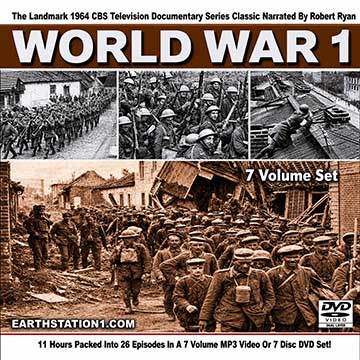
October 24, 1918: The European Civil War:
World War I: The First European War (The European Theater Of World
War I): The Western Front Of World War I: Naval Warfare Of World
War I: The Naval Order Of 24 October 1918: -- Imperial German Navy
Commander Of The High Seas Fleet Admiral Franz Von Hipper, under
orders from Chief Of The German Admiralty Staff Admiral Reinhard
Scheer, promulgates the order to initiate the German Admiralty's
plot, formulated as new German government tried mediate a peaceful
end of World War I, to provoke a decisive battle between the
German High Seas Fleet and the British Grand Fleet in the southern
North Sea in order to prevent the new German govenment from
negotiating and end to the war. When the order to prepare for the
sortie was issued on October 29, mutiny broke out aboard the
German ships. Despite the operation being cancelled, these in turn
led to the far more more serious Kiel mutiny, which was the
starting point of the November Revolution, the German capitulation
to the Allied forces briging an ending to the war, the signing of
Armistice Of 11 November 1918 and the proclamation of the Weimar
Republic. This operation resulted from the exchange of diplomatic
notes, at the insistence of the Supreme Army Command, beginning on
October 5, 1918 between the new German government under Prince Max
of Baden and President Woodrow Wilson, in which Germany asked the
President to mediate an armistice. One of Wilson's preconditions
was the cessation of Germany's submarine war. Despite the
objections of Admiral Scheer, the Chief of the German Admiralty
Staff, the German government made this concession on October 20.
The U-boats at sea were recalled on October 21. In response, on
October 22, Scheer ordered Admiral Hipper, commander of the High
Seas Fleet, to prepare for an attack on the British fleet,
utilising the main battle fleet, reinforced by the newly available
U-boats. Hipper's order was promulgated on October 24; Scheer
approved it on October 27. The fleet then began to concentrate at
Schillig Roads off Wilhelmshaven to prepare for the battle. The
order to prepare for the sortie was issued two days later on
October 29, provoking mutiny aboard the German ships and
ultimately bringing the war to an end.
https://store.earthstation1.com/world-war-1-robert-ryan-4-dual-layer-dvds-26-episode-tv-se1426.html
Today's
EarthStation1.com 15% (Or More!) Off Commemorative Memorial Title:
The Wall Street Crash Of 1929 Documentary Set MP4 Video Download
DVD
Today, October 24, 2026
October 24, 1929: Economics: Markets (Economics): Financial Markets: Exchanges (Bourses, Trading Exchanges, Trading Venues): Stock Exchanges (Securities Exchanges, Bourses): Stock Markets (Equity Markets, Share Markets): Financial Crises: Financial Crises In The United States: Stock Market Crashes: Stock Market Crashes In The United States: Economic Crises: Economic Crises In The United States: Financial Markets Of The United States ("Wall Street"): The New York Stock Exchange (NYSE, The Big Board): The Wall Street Crash Of 1929 (The Wall Street Crash, The Great Crash, The Crash of '29): Black Thursday: -- The Great Crash begins in the New York Stock Exchange as nearly 13 million shares were sold in panic selling. Five days later "Black Tuesday" saw 16 million shares sold. The Wall Street Crash Of 1929, also known as Black Tuesday (October 29), the Great Crash, or the Stock Market Crash of 1929, began on October 24, 1929 ("Black Thursday"), and was the most devastating stock market crash in the history of the United States (acting as the most significant predicting indicator of the Great Depression), when taking into consideration the full extent and duration of its after effects. The crash, which followed the London Stock Exchange' crash of September, signalled the beginning of the 12-year Great Depression that affected all Western industrialized countries. https://store.earthstation1.com/wastcrof19do.html
Today's
EarthStation1.com 15% (Or More!) Off Commemorative Memorial Title:
Al Capone Documentary Biography MP4 Video Download DVD
Today, October 24, 2026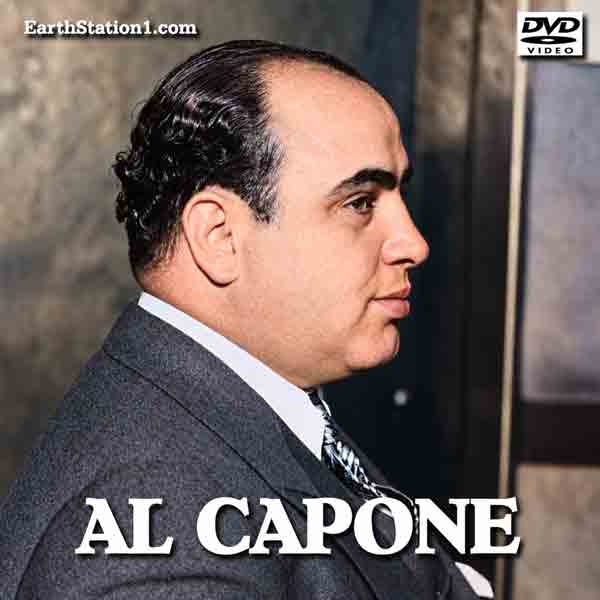
October 24, 1931: Crime In The United
States: Crime: Organized Crime: The Chicago Outfit (The Outfit,
The Chicago Mafia, The Chicago Mob, The Chicago Crime Family, The
South Side Gang, The Organization): Al Capone: -- Chicago gangster
"Scarface" Al Capone, having been convicted of federal
income tax evasion on October 17, 1931, is sentenced to 11 years
in jail, fined 50K USD plus 7,692 USD for court costs, and was
held liable for 215K USD plus interest due on his back taxes. Al
Capone, American mob boss (January 17, 1899 - January 25, 1947)
was born Alphonse Gabriel Capone in the Brooklyn borough of New
York City, New York. Known by the nickname Scarface, Capone was an
American mobster, crime boss and businessman who attained fame
during the Prohibition era as the co-founder and boss of the
Chicago Outfit, also known as the Outfit, the Chicago Mafia, the
Chicago Mob, or The Organization, an Italian-American organized
crime syndicate based in Chicago, Illinois which dates back to the
1910s. His seven-year reign as crime boss ended when he was 33
years old. He reveled in attention, such as the cheers from
spectators when he appeared at ball games. He made donations to
various charities and was viewed by many to be a "modern-day
Robin Hood". However, the Saint Valentine's Day Massacre of
gang rivals, resulting in the killing of seven men in broad
daylight, damaged Chicago's image - as well as Capone's - leading
influential citizens to demand governmental action and newspapers
to dub him "Public Enemy No. 1". The federal authorities
became intent on jailing Capone, and they prosecuted him for tax
evasion in 1931, a federal crime and a novel strategy during the
era. During the highly publicized case, the judge admitted as
evidence Capone's admissions of his income and unpaid taxes during
prior (and ultimately abortive) negotiations to pay the government
any back taxes he owed. Capone was convicted and sentenced to 11
years in federal prison. After conviction, he replaced his old
defense team with experts in tax law, and his grounds for appeal
were strengthened by a Supreme Court ruling, but his appeal
ultimately failed. He was already showing signs of syphilitic
dementia early in his sentence, and he became increasingly
debilitated before being released after eight years. On January
25, 1947, Capone died of cardiac arrest in the hospital of
Alcatraz Federal Penitentiary after suffering a stroke.
https://store.earthstation1.com/al-capone-documentary-biography-mp4-video-download-dv4.html
Today's
EarthStation1.com 15% (Or More!) Off Commemorative Memorial Title:
Perspective On Greatness: Cops Vs Robbers DVD, Download, USB Drive
Today, October 24, 2026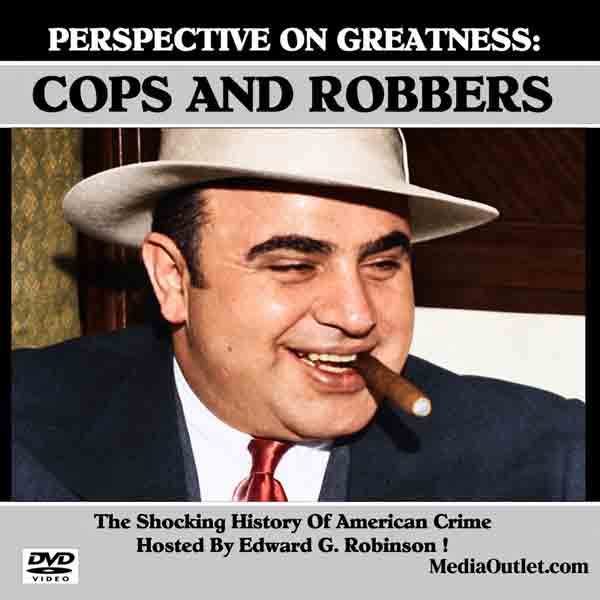
October 24, 1935: #DOTD: Dutch Schultz,
brutal and ruthless American mobster of the Noe-Schultz gang based
in New York City in the 1920s and 1930s, who made his fortune in
organized crime-related activities, including bootlegging and the
numbers racket (b. August 6, 1901) #dies as a result of the
October 23, 1935 mafia hit known as The Chophouse Massacre, when
Dutch Schultz, Abe Landau, Otto Berman, and Bernard "Lulu"
Rosencrantz were fatally shot at Schultz's headquarters, the
Palace Chophouse saloon and restaurant in Newark, New Jersey.
Dutch Schultz died the next day. He is buried at The Gate Of
Heaven Cemetery in Hawthorne, New York. Schultz' last words were a
strange stream-of-consciousness babble, spoken in his hospital bed
to police officers who attempted to calm him and question him for
useful information. Although the police were unable to extract
anything coherent from Schultz, his rambling was fully transcribed
by a police stenographer. This includes the famous: "A boy
has never wept...nor dashed a thousand kim." But the entire
text (linked below) is much more rambling, for example: "You
can play jacks, and girls do that with a soft ball and do tricks
with it.". Oh, Oh, dog Biscuit, and when he is happy he
doesn't get snappy. One of his last utterances was a reference to
"French Canadian bean soup" (French Canadian pea soup is
a popular dish that is still produced as canned goods by many food
companies). Schultz' last words inspired a number of writers to
devote works related to them. Beat Generation author William S.
Burroughs published a screenplay in novel form titled The Last
Words of Dutch Schultz in the early 1970s, while Robert Shea and
Robert Anton Wilson connected Schultz' words to a global
Illuminati-related conspiracy, making them a major part of 1975'
The Illuminatus! Trilogy. (In Wilson' and Shea' story, Schultz'
ramblings are a coded message.) In his 1960 anthology Parodies,
Dwight Macdonald presents Schultz' last words as a parody of
Gertrude Stein. In the novel Billy Bathgate, the protagonist used
clues from Schultz' deathbed ramblings to locate his hidden money.
Several actors have played Dutch Schultz in films: Vic Morrow in
Portrait of a Mobster (1960), Vincent Gardenia in Mad Dog Coll
(1961), James Remar in The Cotton Club (1984), Dustin Hoffman in
Billy Bathgate (1991), Bruce Nozick in Hit the Dutchman (1992),
Lance Henriksen in The Outfit (1993), and Tim Roth in Hoodlum
(1997). In the 1959 The Untouchables episode "The Dutch
Schultz Story", Schultz was played by Lawrence Dobkin. The
building that housed the Palace Chop House was torn down in 2008.
Dutch Schultz was born Arthur Simon Flegenheimer in The Bronx, New
York City to German Jewish immigrants Herman and Emma (Neu)
Flegenheimer, who had married in Manhattan on November 10, 1900.
Herman Flegenheimer apparently abandoned his family; the event
traumatized young Flegenheimer, who spent the rest of his life
denying that his father had abandoned his family. Flegenheimer
dropped out of school in the eighth grade to help support himself
and his mother. Flegenheimer worked at a neighborhood night club
owned by a small-time mobster, where he robbed craps games.
Eventually he was caught breaking into an apartment and sent to
the prison on Blackwell's Island (now called Roosevelt Island).
Flegenheimer's mugshot, aged 18, was published in the 2010 book
New York City Gangland. He proved to be such an unmanageable
prisoner that he was transferred to a work farm in Westhampton,
Long Island. After he was recaptured following an escape, he had
two months added to his sentence. Flegenheimer was released on
parole on December 8, 1920, and went back to work at Schultz
Trucking. With the enactment of the Volstead Act and the start of
Prohibition in the United States, the shipping company began
smuggling liquor and beer into New York City from Canada. This led
Flegenheimer to start associating with known criminals. It was
also during this time that Flegenheimer became better known as
"Dutch" Schultz. Following a disagreement, he left
Schultz Trucking and went to work for their Italian competitors.
In the mid-1920s, Schultz had begun work as a bouncer at the Hub
Social Club, a small speakeasy in the Bronx owned by a gangster
named Joey Noe. Noe was impressed with Schultz's ruthlessness and
reputation for brutality when he lost his temper, and he made him
a partner. Together they soon opened more illegal drinking joints
around the Bronx. Using their own trucks to reduce high delivery
costs, they brought in beer made by Frankie Dunn, a brewer in
Union City, New Jersey. Schultz often rode shotgun to guard the
trucks from hijackers. Schultz and Noe soon had to deal with the
brothers John and Joe Rock, who were already running a bootlegging
operation in the Bronx. Initially the brothers refused to buy beer
from Noe and Schultz, but eventually John, the elder brother,
agreed to cooperate; however, his younger brother Joe refused. One
night the Noe-Schultz gang kidnapped Joe, beat him and hung him by
his thumbs from a meat hook. They then allegedly wrapped a gauze
bandage smeared with discharge from a gonorrhea infection over his
eyes. His family reportedly paid 35K USD for his release. Shortly
after his return, he went blind. From then on, the Noe-Schultz
gang met little opposition as they expanded across the entire
Bronx. Bootlegging during Prohibition made Schultz very wealthy.
The Noe-Schultz operation, which had begun to flourish in the
Bronx, soon became the only gang able to rival the network of
Italian crime syndicates that became the Mafia's Five Families.
When the gang expanded from the Bronx over to Manhattan's Upper
West Side and the neighborhoods of Washington Heights, Yorkville
and Harlem, they moved their headquarters to East 149th Street in
The Bronx. However, this brazen move led to a bootleg war with New
York's Irish Mob, led by Jack "Legs" Diamond. In the
early hours of October 16, 1928, Noe was shot several times
outside the Chateau Madrid, a speakeasy at 231 West 54th. Although
seriously wounded, he managed to return fire. A blue Cadillac was
seen hitting some parked cars and losing one of its doors before
speeding away. When police found the car an hour later, they
discovered the body of a Louis Weinberg (no relation to Schultz
gang members Abraham "Bo" Weinberg and George Weinberg)
in the back seat. Noe's wounds became infected and he died on
November 21. Schultz was left angry and distraught by the loss of
his friend and mentor. Retaliation started a few weeks later when
Arnold Rothstein, a kingpin in the Jewish mob, was found fatally
shot near the service entrance to the Park Central Hotel on
November 6, 1928. Although George "Hump" McManus
supposedly killed Rothstein over a bad gambling debt, Schultz is
believed to have ordered the killing in retribution for Noe's
death. On October 12, 1930, Legs Diamond was shot and wounded at
the Hotel Monticello on Manhattan's West Side. Two gunmen forced
their way into Diamond's room and shot him five times before
fleeing. Still in his pajamas, Diamond staggered into the hallway
and collapsed. When asked later by the New York Police
Commissioner how he managed to walk out of the room, Diamond said
he drank two shots of whiskey first. Diamond was rushed to the
Polyclinic Hospital in Manhattan, where he eventually recovered.
On December 30, 1930, Diamond was discharged from Polyclinic.
During his absence, his gang was forced to leave the city. When he
returned home, Diamond began carving out a new territory for
himself in Albany. He was killed in a cheap Albany rooming house
at 67 Dove Street by two gunmen in December 1931. Schultz also had
to deal with internecine conflicts within his own gang. In 1930,
one of Schultz's enforcers, Vincent Coll, demanded to be made an
equal partner. This was because Schultz gang members received a
flat salary instead of the customary percentage from the take-a
unique arrangement compared to other major gangs in organized
crime. When Schultz refused, Coll formed his own crew with the
ultimate goal of murdering Schultz and taking over his territory.
In the bloody gang war that followed, Coll lost his older brother
Pete and earned the nickname "Mad Dog" from the press
after a child was killed during a botched assassination attempt
committed by his gang. In February 1932, Coll was lured into a
trap. While he was taking a call in a drugstore phone booth,
gunmen entered the store and machine-gunned him to death. The
killers may have included Edward "Fats" McCarthy and the
brothers Bo and George Weinberg. Along with the numbers rackets,
Schultz began extorting New York restaurant owners and workers.
Schultz, working through a hulking gangster named Jules
Modgilewsky, also known as Julie Martin, made deals with the
leaders of Waiters Local 16 and Cafeteria Workers Local 302 to
extort money by forcing restaurant owners to join the Metropolitan
Restaurant & Cafeteria Owners Association, an employer
association that Schultz had founded. Those who refused to join
the Association were faced with exorbitant wage demands from the
unions, followed by strikes and stink bomb attacks. The
Metropolitan Association then stepped in to arrange a settlement
of the strike with a sweetheart contract for low wages contingent
on the employer joining the Association. Martin/Modgilewsky
successfully extracted thousands of dollars of tributes and "dues"
from the terrorized restaurant owners for Schultz. He began to
suspect that Martin was skimming from the shakedown operation;
Schultz had recently discovered a $70,000 disparity in the books.
On the evening of March 2, 1935, Schultz invited Martin to a
meeting at the Harmony Hotel in Cohoes, New York. At the meeting,
at which chief enforcer Bo Weinberg and mob lawyer Dixie Davis
were also present, Martin belligerently denied Schultz's charges
and began arguing with him. Both men were drinking heavily as the
argument continued, and Schultz sucker-punched Martin. Finally,
Martin admitted that he had taken $20,000, which he believed he
was "entitled to" anyway. Dixie Davis related what
happened next: "Dutch Schultz was ugly; he had been drinking
and suddenly he had his gun out. Schultz wore his pistol under his
vest, tucked inside his pants, right against his belly. One jerk
at his vest and he had it in his hand. All in the same quick
motion he swung it up, stuck it in Jules Martin's mouth and pulled
the trigger. It was as simple and undramatic as that-just one
quick motion of the hand. Dutch Schultz did that murder just as
casually as if he were picking his teeth." As Martin
contorted on the floor, Schultz apologized to Davis for killing
someone in front of him. When Davis later read a newspaper story
about Martin's murder, he was shocked to find out that the body
was found on a snow bank with a dozen stab wounds to the chest.
When Davis asked about this, Schultz replied, deadpan, "I cut
his heart out." In the early 1930s, U.S. Attorney Thomas
Dewey had set his sights on convicting Schultz for non-payment of
federal taxes. Schultz was indicted in New York in January 1933
and became a fugitive. (Dewey subsequently left the Justice
Department, first for private practice, then as a state-appointed
Special Prosecutor and D.A.) Schultz surrendered in Albany, New
York, in November 1934. This was part of his plan to have his
trials moved from New York City to upstate. His first tax evasion
trial, in Syracuse, ended in a hung jury, with many speculating
he'd bribed the jurors. He would face retrial in Malone, New York.
With the case going to a second trial, Schultz quickly set about
presenting himself to the townspeople of Malone as a country
squire and good citizen. He donated cash to local businesses, gave
toys to sick children, and performed other charitable deeds. The
strategy worked, as he was acquitted of tax evasion in late summer
1935. The mayor of New York, Fiorello La Guardia, was so outraged
at the verdict that he issued an order that Schultz should be
arrested on sight should he return to the city. As a result,
Schultz was forced to relocate his base of operations across the
Hudson River to Newark. As his defense costs to fight his tax case
mounted, Schultz had found it necessary to reduce the commission
he paid to those running his policy rackets to bolster what he
called the "Arthur Flegenheimer Defense Fund." That
tactic angered the runners and the games' controllers, who,
despite being threatened with violence for showing any dissent,
hired a hall, held a mass protest meeting, and declared a strike
of sorts. Very quickly the cash flow dried up, and Schultz was
forced to back down, which permanently damaged the relationship
between his gang and their associates. Bo Weinberg, Schultz's
chief lieutenant, was so concerned about the amount of money that
Schultz was taking from the rackets to fund his legal defense that
he sought advice from New Jersey mob boss Longy Zwillman, who put
him in touch with the Sicilian-born gangster Charlie "Lucky"
Luciano. The deal that Weinberg wanted was to retain a percentage
and keep overall control of the Schultz gang. However, Luciano
planned to break up the gang's rackets and territory among his own
associates once Schultz was convicted of tax evasion. Believing
that a guilty verdict was a foregone conclusion at the second
trial, Luciano and his allies implemented their plan to take
control. Their plan met little resistance because of the ongoing
bad feelings over the attempted pay cuts and the support of
Weinberg. However, after Schultz was acquitted, he quickly
arranged a meeting with Luciano through the Commission to clarify
the situation. Luciano explained to Schultz that they were just
"looking after the shop" while he was away to ensure
that everything ran smoothly and that full control of his rackets
would be returned to Schultz once the heat died down. Publicly,
Schultz was forced to accept that version of events because of the
ongoing attention from law enforcement agencies and Thomas Dewey,
now a Special Prosecutor appointed by LaGuardia. A month after his
acquittal, his own chief lieutenant Bo Weinberg was never seen
again after he had walked out of a midtown Manhattan nightclub.
Schultz had proposed to the National Crime Syndicate, a
confederation of mobsters, that Dewey be murdered. Luciano argued
that a Dewey assassination would precipitate a massive law
enforcement crackdown. The Commission later voted unanimously
against the proposal. An enraged Schultz said he would kill Dewey
anyway and walked out of the meeting. The Murder, Inc. leader
Albert Anastasia approached Luciano with information that Schultz
had asked him to stake out Dewey's apartment building on Fifth
Avenue. Upon hearing the news, the Commission held a discreet
meeting to discuss the matter. After six hours of deliberations,
the Commission ordered Louis Buchalter to eliminate "The
Dutchman."
https://store.earthstation1.com/perspective-on-greatness-cops-and-robbers-dvd.html
Today's
EarthStation1.com 15% (Or More!) Off Commemorative Memorial Title:
The Battle Of Leyte Gulf DVD, MP4 Video Download, USB Flash Drive
Today, October 24, 2026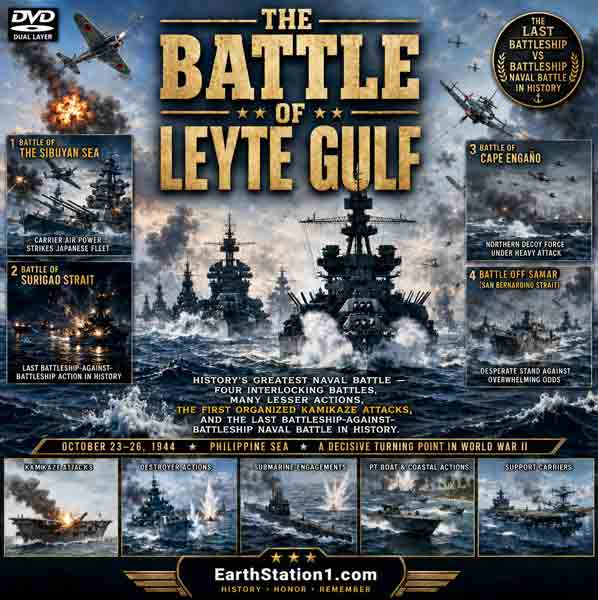
October 24, 1944: World War II: The
Pacific War (The Asia-Pacific War, The Asiatic-Pacific Theater,
The Pacific Theater Of World War II): The Pacific Ocean Theater Of
World War II: The Southwest Pacific Theater Of World War II: The
Philippines Campaign (1944-1945) (Battle Of The Philippines,
Second Philippines Campaign, The Liberation Of The Philippines,
Operation Musketeer I, II, and III): The Battle Of Leyte Gulf: The
Battle Of Sibuyan Sea: -- During the largest naval battle in
history, Japan's center force is temporarily repulsed as the
Japanese battleship Musashi, one of the largest battleships ever
built, is sunk after being struck by an estimated 19 torpedoes and
17 bombs in one day by multiple waves of attacks by American
Curtiss SB2C Helldiver dive bombers, Grumman TBF Avenger torpedo
planes and Grumman F6F Hellcat fighters from the American fleet
carriers USS Intrepid, USS Essex, USS Lexington and USS Franklin,
and the light carrier USS Cabot. The USS Princeton (CVL-23), a
United States Navy Independence-class light aircraft carrier, is
scuttled after a lone Japanese Yokosuka D4Y "Judy" dive
bomber drops a single bomb which struck the carrier between the
elevators, punching through the wooden flight deck and hangar
before exploding and causing irreparable damage; its battle flag
was rededicated in a November 2004 Princeton University Chapel
ceremony, and now hangs in the University of Princeton library.
The Battle Of Leyte Gulf, the largest naval battle in history,
took place off the Philippine Islands. The battle involved 216
U.S. warships and 64 Japanese ships and resulted in the
destruction of the Japanese Navy including the Japanese Battleship
Musashi. It was fought in waters near the Philippine islands of
Leyte, Samar and Luzon, from October 23-26, 1944, between combined
American and Australian forces and the Imperial Japanese Navy. On
October 20, United States troops invaded the island of Leyte as
part of a strategy aimed at isolating Japan from the countries it
had occupied in Southeast Asia, and in particular depriving
Japanese forces and industry of vital oil supplies. The Imperial
Japanese Navy (IJN) mobilized nearly all of its remaining major
naval vessels in an attempt to defeat the Allied invasion but was
repulsed by the U.S. Navy' Third and Seventh Fleets. The IJN
failed to achieve its objective, suffered heavy losses, and never
sailed to battle in comparable force thereafter. The majority of
its surviving heavy ships, deprived of fuel, remained in their
bases for the rest of the Pacific War and suffered under heavy
sustained aerial attack. The battle consisted of several separate
engagements between the opposing forces: The Battle Of The Sibuyan
Sea, The Battle Of Surigao Strait, The Battle Of Cape Engano and
The Battle Off Samar, as well as other actions. This was the first
battle in which Japanese aircraft carried out organized kamikaze
attacks. By the time of the battle, Japan had fewer naval ships
than the Allied forces had aircraft carriers, underscoring the
disparity in force strength at this point in the war.
https://store.earthstation1.com/the-battle-of-leyte-gulf-dvd-mp4-download-usb-flash-driv4.html
Today's
EarthStation1.com 15% (Or More!) Off Commemorative Memorial Title:
The Twentieth Century With Walter Cronkite TV Series 10 MP4s / 10
DVDs
Today, October 24, 2026
October 24, 1946: Rocket Launches: The
History Of Rocketry: Science And Technology During World War II:
Science And Technology In Nazi Germany: Research And Development
In Nazi Germany (R & D In Nazi Germany): Wunderwaffen (German:
"Wonder Weapons", "Miracle Weapons");
V-Weapons (German: Vergeltungswaffen, "Vengeance Weapons",
"Retaliatory Weapons", "Reprisal Weapons"):
The V-2 (The V-2 Rocket, German: Vergeltungswaffe 2, "Vengeance
Weapon 2"; Aggregat 4, German: "Aggregate 4", A-4):
The V-2 Sounding Rocket: The Aftermath Of World War II: The Cold
War: Captured V-2 Rockets: American Captured V-2 Rockets: V-2 No.
13 (The White Sands Rocket): -- A camera on board the V-2 No. 13
rocket takes the first photograph of earth from outer space. It
was a modified V2 rocket launched from The White Sands V-2
Launching Site at The White Sands Proving Ground (now known as The
White Sands Missile Range) in White Sands, New Mexico, that became
the first man-made object to take a photograph of the Earth from
outer space. The rocket reached a maximum altitude of 65 miles
(105 km). The famous photograph was taken with an attached DeVry
35mm black-and-white motion picture camera. This motion picture
serves as the episode opening segment of "The Twentieth
Century With Walter Cronkite" television documentary series.
https://store.earthstation1.com/the-twentieth-century-with-walter-cronkite-5-dual-layer-dvd5.html
Today's
EarthStation1.com 15% (Or More!) Off Commemorative Memorial Title:
Dangerous Years President Eisenhower And The Cold War DVD, MP4,
USB
Today, October 24, 2026
October 24, 1954: The Aftermath Of World
War II: The Cold War: The Indochina Wars: The First Indochina War
(1946-1954) (The Indochina War, The Anti-French Resistance War,
The French-Indochina War): The Korean Conflict: The 1954 Geneva
Conference (The Geneva Conference): -- In an explicit subversion
of the Geneva Conference agreements, Dwight D. Eisenhower, on the
tragic urging the Dulles Brothers, pledges United States support
to South Vietnam, knowing that South Vietnam's President Diem
planned not to hold elections as he had obligated himself to do at
The Geneva Conference. On July 21, 1954, the First Indochina War
between France and the Viet Minh was ended with The Geneva
Conference agreement, which partitioned Vietnam into North Vietnam
and South Vietnam, with a provision that a national election would
take place in 1956 to decide on a single national government for a
unified Vietnam. The United States did not sign the Geneva
Conference agreement, and shortly after the conference ended,
advisors to President Eisenhower such as Allen Dulles and John
Foster Dulles informed the President that Ngo Dinh Diem, the Prime
Minister of the southern half of Vietnam known as The State of
Vietnam, planned not to have the elections occur, and that in
their opinion the United States should secretly support him in
that decision. It was on this basis that President Eisenhower
publicly pledged his support to Ngi Dinh Diem's state.
https://store.earthstation1.com/dangerous-years-president-eisenhower-and-the-cold-war-dvd.html
Today's
EarthStation1.com 15% (Or More!) Off Commemorative Memorial Title:
The Struggles For Poland TV Series + Bonus MP4 Video Download DVD
Set
Today, October 24, 2026
October 24, 1980: Eastern Block
Non-Violent Revolutions: The Labor Union Movement In Poland:
Solidarity (Polish Trade Union) (Independent Self-Governing Trade
Union Solidarity, Solidarnosc): -- The government of Poland
legalizes the Solidarity trade union; by 1982, Poland would ban
Solidarity and all other trade unions. Solidarity (Polish:
Solidarnosc; full name: Independent Self-governing Labour Union
"Solidarity"-Niezalezny Samorzadny Zwiazek Zawodowy
"Solidarnosc") is a Polish labour union that was founded
on September 17, 1980 at the Lenin Shipyard under the leadership
of Lech Walesa. It was the first trade union in a Warsaw Pact
country that was not controlled by a communist party. Its
membership peaked at 10 million members at its September 1981
Congress, which constituted one third of the total working-age
population of Poland. In the 1980s, Solidarity was a broad
anti-bureaucratic social movement, using the methods of civil
resistance to advance the causes of workers' rights and social
change. The government attempted to destroy the union by imposing
martial law in Poland, which lasted from December 1981 to July
1983 and was followed by several years of political repression
from 8 October 1982, but in the end it was forced to negotiate
with Solidarity. In the union's clandestine years, Pope John Paul
II and the United States provided significant financial support,
estimated to be as much as 50M USD. The round table talks between
the government and the Solidarity-led opposition led to semi-free
elections in 1989. By the end of August, a Solidarity-led
coalition government was formed. In December 1990, Walesa was
elected President of Poland. Since then Solidarity has become a
more traditional, liberal trade union. Its membership had dropped
to 680,000 by 2010 and 400,000 by 2011; as of 2025, their official
website solidarnosc.org.pl does not publish the total number of
their membership.
https://store.earthstation1.com/the-struggles-for-poland-dvd-set-all-9-shows-5-dis95.html
Today's
EarthStation1.com 15% (Or More!) Off Commemorative Memorial Title:
Wings Over The World: Aviation History Series + Bonus MP4 Or DVD
Set
Today, October 24, 2026
October 24, 2003: Aviation: The History
Of Aviation: The History Of Civil Aviation: Final Flights: --
Concorde makes its last commercial flight as British Airways
retires its Concorde fleet. G-BOAG left New York to a fanfare
similar to that given for Air France's F-BTSD, while two more made
round trips, G-BOAF over the Bay of Biscay, carrying VIP guests
including former Concorde pilots, and G-BOAE to Edinburgh. The
three aircraft then circled over London, having received special
permission to fly at low altitude, before landing in sequence at
Heathrow. The captain of the New York to London flight was Mike
Bannister. The final flight of a Concorde in the US occurred on
November 5, 2003 when G-BOAG flew from New York's JFK Airport to
Seattle's Boeing Field to join the Museum of Flight's permanent
collection. The plane was piloted by Mike Bannister and Les
Broadie, who claimed a flight time of three hours, 55 minutes and
12 seconds, a record between the two cities. The museum had been
pursuing a Concorde for their collection since 1984. The final
flight of a Concorde worldwide took place on November 26, 2003
with a landing at Filton, Bristol, UK. Concorde was a
British-French turbojet-powered supersonic passenger airliner that
was operated from 1976 until 2003. It had a maximum speed over
twice the speed of sound at Mach 2.04 (1,354 mph or 2,180 km/h at
cruise altitude), with seating for 92 to 128 passengers. First
flown in 1969, Concorde entered service in 1976 and continued
flying for the next 27 years. It is one of only two supersonic
transports to have been operated commercially; the other is the
Soviet-built Tupolev Tu-144, which operated in passenger service
from 1977 to 1978. Concorde was jointly developed and manufactured
by Sud Aviation (later Aerospatiale) and the British Aircraft
Corporation (BAC) under an Anglo-French treaty. Twenty aircraft
were built, including six prototypes and development aircraft. Air
France (AF) and British Airways (BA) were the only airlines to
purchase and fly Concorde. The aircraft was used mainly by wealthy
passengers who could afford to pay a high price in exchange for
the aircraft's speed and luxury service. For example, in 1997, the
round-trip ticket price from New York to London was 7,995 USD,
more than 30 times the cost of the cheapest option to fly this
route. The original program cost estimate of 70 million Pounds
Sterling met huge overruns and delays, with the program eventually
costing 1.3 billion Pounds Sterling. It was this extreme cost that
became the main factor in the production run being much smaller
than anticipated. Later, another factor which affected the
viability of all supersonic transport programmes was that
supersonic flight could only be used on ocean-crossing routes, to
prevent sonic boom disturbance over populated areas. With only
seven airframes each being operated by the British and French, the
per-unit cost was impossible to recoup, so the French and British
governments absorbed the development costs. British Airways and
Air France were able to operate Concorde at a profit, in spite of
very high maintenance costs, because the aircraft was able to
sustain a high ticket price. Among other destinations, Concorde
flew regular transatlantic flights from London's Heathrow Airport
and Paris's Charles de Gaulle Airport to John F. Kennedy
International Airport in New York, Washington Dulles International
Airport in Virginia, and Grantley Adams International Airport in
Barbados; it flew these routes in less than half the time of other
airliners. Concorde's name, meaning "harmony" or
"union", was chosen to reflect the co-operation on the
project between the United Kingdom and France. In the UK, any or
all of the type are known simply as Concorde, with no definite
article "the". Concorde won the 2006 Great British
Design Quest organised by the BBC and the Design Museum, beating
other well-known designs such as the BMC Mini, the miniskirt, the
Jaguar E-Type, the London Tube map and the Supermarine Spitfire.
The type was retired in 2003, three years after the crash of Air
France Flight 4590, in which all passengers and crew were killed.
The general downturn in the commercial aviation industry after the
September 11 attacks in 2001 and the end of maintenance support
for Concorde by Airbus (the successor company of both Aerospatiale
and BAC) also contributed.
https://store.earthstation1.com/wings-over-the-world-7-dvd-set-entire-aviation-tv-serie7.html
Today's
EarthStation1.com 15% (Or More!) Off Commemorative Memorial Title:
Great Depression Films Collection DVD, Video Download, USB Flash
Drive
Today, October 24, 2026
October 24, 2008: Economics: Markets
(Economics): Financial Markets: Exchanges (Bourses, Trading
Exchanges, Trading Venues): Stock Exchanges (Securities Exchanges,
Bourses): Stock Markets (Equity Markets, Share Markets): Financial
Crises: Financial Crises In The United States: Stock Market
Crashes: Stock Market Crashes In The United States: Economic
Crises: Economic Crises In The United States: Financial Markets Of
The United States ("Wall Street"): The New York Stock
Exchange (NYSE, The Big Board): The Financial Crisis Of 2007-2008:
The Stock Market Crash Of 2008-2009: Bloody Friday: -- Many of the
world' stock exchanges experience the worst declines in their
history, with drops of around 10% in most indices. Caused in large
part by the subprime mortgage crisis that developed into a
full-blown international banking crisis with the collapse of the
investment bank Lehman Brothers on September 15, 2008, it served
to usher in the Great Recession.
https://store.earthstation1.com/great-depression-films-2-dvd-se2.html
Today's
EarthStation1.com 15% (Or More!) Off Commemorative Memorial Title:
Choppers: Helicopter History TV Documentary Series DVD, Download,
USB
Today, October 24, 2026
October 24, 1919: #BOTD: #HBD! Frank
Piasecki, American engineer and helicopter aviation pioneer,
initial proponent of tandem rotor helicopter designs and creator
of the compound helicopter concept of vectored thrust using a
ducted propeller (d. February 11, 2008) is #born Frank Nicolas
Piasecki in Philadelphia, Pennsylvania to an immigrant Polish
tailor. Piasecki worked for autogyro manufacturers while still
attending Overbrook High School, then studied mechanical
engineering at the University of Pennsylvania before graduating
with a bachelor's degree from New York University. He was employed
by the Platt-LePage Aircraft Company as a control engineer on
their XR-1 twin-rotor project. In 1940, he formed PV Engineering
Forum with former Pennsylvania classmate Harold Venzie. He built a
single-person, single-rotor helicopter designated the PV-2 and
flew it on April 11, 1943. This helicopter impressed the United
States Navy sufficiently to win Piasecki a development contract.
The name PV Engineering was changed to Piasecki Helicopter
Corporation in 1946. After a boardroom dispute, Piasecki was
forced out of Piasecki Helicopter in 1955, and formed the Piasecki
Aircraft Company. At Piasecki Aircraft, he participated in the
development of the Piasecki 16H-1 the world's first shaft driven
compound helicopter, the PA-59K/VZ-8P Flying Geep (also known as
the AirGeep) the Piasecki PA-97 Helistat heavy vertical airlifter
and the Piasecki X-49 experimental compound helicopter. Piasecki
married Vivian Weyerhaeuser on December 20, 1958.[8] They had
seven children: Nicole, Frederick, John, Lynn, Frank, Michael, and
Gregory. His son John W. Piasecki is now President and CEO of
Piasecki Aircraft. His son Fred W. Piasecki is Chairman of the
Board and Chief Technology Officer of Piasecki Aircraft. His
daughter Nicole Piasecki was the vice president and general
manager of Propulsion Systems for Boeing Commercial Airplanes.
Frank Piasecki died at his home in Haverford, Pennsylvania, of a
heart attack after a series of strokes, aged 88. He is buried at
Calvary Cemetery in West Conshohocken, Pennsylvania.
https://store.earthstation1.com/choppers-complete-13-part-tv-series-4-dvd-134.html
Today's
EarthStation1.com 15% (Or More!) Off Commemorative Memorial Title:
Junior G-Men Of The Air Radio Series Dead End Kids MP3 Set CD, USB
Today, October 24, 2026
October 24, 1903: #BOTD: #HBD! Melvin
Purvis, American law enforcement official and Federal Bureau of
Investigation (FBI) agent (d. February 29, 1960) is #born Melvin
Horace Purvis II in Timmonsville, South Carolina, to Melvin Horace
Purvis, Sr. (1869-1938), a tobacco farmer and businessman, and
Janie Elizabeth (nee Mims, 1874-1927); he was the fifth of eight
siblings. Given the nickname "Little Mel" because of his
short, 5 ft 4 in frame, Purvis became noted for leading the
manhunts that captured bank robbers such as Baby Face Nelson, John
Dillinger, and Pretty Boy Floyd, but his high public profile was
resented by local law enforcement. Purvis asserted he had killed
Floyd single-handed, others variously claimed that Floyd had been
already wounded, or even that Purvis had ordered Floyd summarily
shot dead for refusing to provide information. Purvis had the
reputation of using very tough methods against recalcitrant
interviewees. Roger Touhy, a minor-league gangster who was
arrested as Purvis fought the huge Capone organisation during
Prohibition, alleged he suffered the loss of 25 lbs of body weight
and several teeth plus broken vertebrae due to being beaten every
time he fell asleep during weeks of questioning by Purvis's men.
Purvis became the FBI's golden boy, having captured more of
designated public enemies than any other agent, but found himself
sidelined after he began to enjoy better press than J. Edgar
Hoover. Purvis was a well-educated man, and known to be a crack
shot. He received his law degree from the University of South
Carolina School of Law and had a brief career as a lawyer. Purvis
was a member of the Kappa Alpha Order while attending South
Carolina. He joined the FBI in 1927 and headed the Division of
Investigation offices in Birmingham, Oklahoma City, and
Cincinnati. In 1932, he was placed in charge of the Chicago office
by Bureau of Investigation Director J. Edgar Hoover. Purvis led
the manhunts that tracked outlaws Baby Face Nelson and Pretty Boy
Floyd, and most famously John Dillinger, which ended in Chicago on
July 22, 1934. However, after Purvis became a media figure for
this feat, Hoover claimed that Purvis had been demoted and agent
Samuel P. Cowley had been put in charge of the Dillinger case.
Cowley was later shot by Baby Face Nelson, and Purvis visited him
in the hospital shortly before he died. Purvis was praised for his
actions. He reportedly incurred the wrath of Hoover, who had
previously supported him but now supposedly felt overshadowed. In
a 2005 book co-authored by Purvis's son Alston, Hoover is
portrayed as jealous of the attention given to Purvis after
Dillinger was killed. At least one of Purvis's official accounts
of his exploits was later called into question. Purvis's story of
the death of Pretty Boy Floyd indicated that Purvis and his agents
had killed him with no assistance from local law enforcement. This
was later disputed by Chester Smith, an officer with the East
Liverpool, Ohio police (Hoover would later state Smith had shot
Floyd first). Officer Smith said that Purvis and his agents never
fired until after Purvis had attempted to question Floyd. After
Floyd responded with curses, Purvis ordered Agent Herman "Ed"
Hollis to shoot Floyd, who was lying wounded on the ground. This
claim was discounted later by retired FBI Agent Winfred E. Hopton,
who wrote in a 1976 letter to TIME that local law enforcement,
including Captain Smith, weren't even present until after Floyd
had died. Of course, this version conflicts with the one from
local authorities which has Smith initially wounding Floyd.
Neither claim has been clearly proven. Purvis resigned from the
FBI in 1935 and afterwards practiced law. In 1937, he became
engaged to actress Janice Jarratt, but they never married. He
later married Marie Rosanne Willcox, and they had three sons. In
1936, Purvis published a memoir of his years as an investigator
with the Bureau, entitled American Agent. Purvis served in the
United States Army as an intelligence officer during World War II,
reaching the rank of colonel. He assisted with compiling evidence
against Nazi leaders in the Nuremberg trials. On February 29,
1960, Purvis was at his home in Florence, South Carolina, when he
died from a gunshot wound to the head, aged 56; the shot was fired
from the pistol that was given to him by fellow agents when he
resigned from the FBI. The FBI investigated his death and declared
it a suicide, although the official coroner's report did not label
the cause of death as such. A later investigation suggested that
Purvis may have shot himself accidentally while trying to extract
a tracer bullet jammed in the pistol, which is unlikely
considering his skill with firearms. He is buried at Mount Hope
Cemetery in Florence, South Carolina.
https://store.earthstation1.com/junior-gmen-of-the-air-mp3-cd-old-time-radio-dead-end-kid3.html
Today's
EarthStation1.com 15% (Or More!) Off Commemorative Memorial Title:
Batman And Robin And The Great Super Heroes 1989 DVD MP4 Download
USB
Today, October 24, 2026
October 24, 1915: #BOTD: #HBD! Bob Kane,
American comic book writer, animator and artist who co-created,
with Bill Finger, the DC Comics character Batman (d. November 3,
1998) is #born Robert Kahn in New York City, New York into a
family of Ashkenazi Jewish descent. Kane also co-created the
animated series Courageous Cat and Minute Mouse and Cool McCool.
Bob Kane died of natural causes at Cedars-Sinai Medical Center in
Los Angeles at age 83. He is buried at Forest Lawn Memorial Park
in the Hollywood Hills of Los Angeles, California. He was inducted
into the comic book industry's Jack Kirby Hall of Fame in 1993 and
into the Will Eisner Comic Book Hall of Fame in 1996. Bob Kane
died of natural causes at Cedars-Sinai Medical Center in Los
Angeles at age 83. He is buried at Forest Lawn Memorial Park in
the Hollywood Hills of Los Angeles, California.
https://store.earthstation1.com/batman-and-robin-amp-the-great-super-heroes-dvd-1989.html
Today's
EarthStation1.com 15% (Or More!) Off Commemorative Memorial Title:
Hamlet (1990) Kevin Kline Diane Venora DVD, Download, USB Flash
Drive
Today, October 24, 2026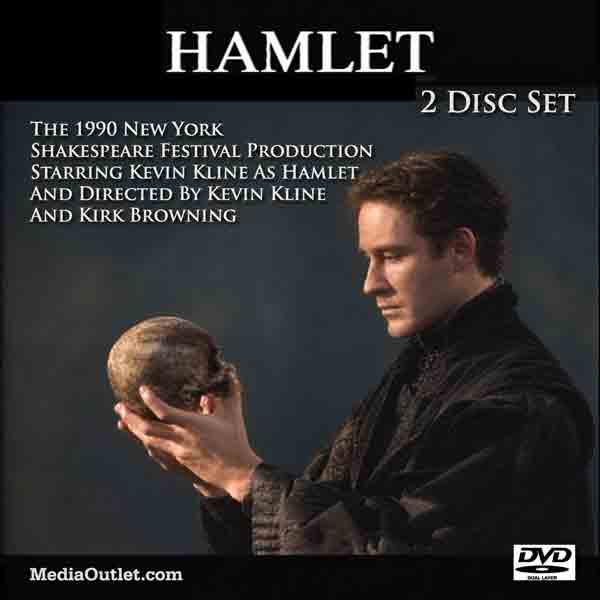
October 24, 1947: #BOTD: #HBD! Kevin
Kline, American American film and stage actor, comedian, singer,
and voice artist is #born Kevin Delaney Kline in St. Louis,
Missouri. He has won an Oscar and three Tony Awards and is a 2003
American Theatre Hall of Fame inductee. Kline began his career on
stage in 1972 with The Acting Company. He has gone on to win three
Tony Awards for his work on Broadway, winning Best Featured Actor
in a Musical for the 1978 original production of On the Twentieth
Century, Best Actor in a Musical for the 1981 revival of The
Pirates of Penzance, and Tony Award for Best Actor in a Play for
the 2017 revival of Present Laughter. He made his film debut in
Sophie's Choice (1982). For his role in the 1988 comedy hit A Fish
Called Wanda, he won the Academy Award for Best Supporting Actor.
In 2003, he starred as Falstaff in the Broadway production of
Henry IV, for which he won the Drama Desk Award for Outstanding
Actor in a Play. He has been nominated for 2 Emmy Awards, two
BAFTA Awards and five Golden Globe Awards. His other films include
The Big Chill (1983), Silverado (1985), Cry Freedom (1987), Grand
Canyon (1991), Dave (1993), The Hunchback of Notre Dame (1996),
The Ice Storm (1997), In & Out (1997), Wild Wild West (1999),
The Road to El Dorado (2000), De-Lovely (2004), The Conspirator
(2010), My Old Lady (2014), and Beauty and the Beast (2017). Since
2011, Kline has had a recurring role on the animated comedy series
Bob's Burgers.
https://store.earthstation1.com/hamlet-1990-dvd-kevin-kline-ny-shakespeare-festival-2-19902.html
Today's
EarthStation1.com 15% (Or More!) Off Commemorative Memorial Title:
Largo Desolato (1990) Vaclav Havel Play DVD, Video Download, USB
Drive
Today, October 24, 2026
October 24, 1939: #BOTD: #HBD! F. Murray
Abraham, American actor is #born Murray Abraham in Pittsburgh,
Pennsylvania into a Syrian Christian and Italian American
ancestry. F. Murray Abraham became widely known during the 1980s
after winning an Oscar for his leading role as Antonio Salieri in
the drama film Amadeus (1984). Abraham also won a Golden Globe and
received a BAFTA Award nomination for the role. He has appeared in
many roles, both leading and supporting, in films such as All the
President's Men (1976), Scarface (1983), The Name of the Rose
(1986), Last Action Hero (1993), Star Trek: Insurrection (1998),
Finding Forrester (2000), Inside Llewyn Davis (2013), and The
Grand Budapest Hotel (2014). Abraham is also known for his
television and theatre work and is a regular cast member on the
television series Homeland, which earned him two Primetime Emmy
Award nominations.
https://store.earthstation1.com/largo-desolato-dvd-vaclav-havel-semiautobiographical-play.html
Today's
EarthStation1.com 15% (Or More!) Off Commemorative Memorial Title:
Martin Mull Presents The History Of White People In America DVD
MP4 USB
Today, October 24, 2026
October 24, 1986: Aesthetics: Performing
Arts: Premieres: Television Premieres: United States Television
Premieres: -- Season Two of Martin Mull's cable television comedy
series The History Of White People premieres on Cinemax. Martin
Mull Presents The History Of White People In America, also known
as The History of White People in America, was a series of
30-minute mockumentary-style vignettes, first broadcast, beginning
in 1985, on Cinemax. Martin Mull Presents The History Of White
People In America, Part 1: In Search Of was broadcast June 4, 1985
at 9:30 PM. It was hosted by Martin Mull, and starred Fred
Willard, Mary Kay Place, Amy Lynne, Christian Jacobs, and Edie
McClurg. It was written and produced by Martin Mull and Allen
Rucker, and directed by Harry Shearer. Mull's wife Wendy Haas
contributed the music. The History of White People in America was
done in the style of documentaries about minorities in the United
States. The focus is a family of empty-headed white people
clueless about the complexities of the world around them. Each
30-minute segment focuses on a particular theme (e.g. religion,
crime). Martin Mull plays a reporter after the fashion of
60-Minutes investigative TV journalism, interviewing participants
as well as providing narration or commentary directly into the
camera.
https://store.earthstation1.com/martin-mull-presents-the-history-of-white-people-in-america-dvd.html
Today's
EarthStation1.com 15% (Or More!) Off Commemorative Memorial Title:
John Hammond: Bessie Smith to Bruce Springsteen DVD, MP4, Flash
Drive
Today, October 24, 2026
October 24, 1911: #BOTD: #HBD! Sonny
Terry, also known as Blind Sonny Terry, African American blues and
folk music singer, harmonica player and Jew's harp player (d.
March 11, 1986) is #born Saunders Teddell (or Saunders Terrell or
other variants; sources differ) in Greensboro, Georgia. Terry was
known for his energetic blues harmonica style, which frequently
included vocal whoops and hollers and occasionally imitations of
trains and fox hunts. Terry's father, a farmer, taught him to play
basic blues harp as a youth. He sustained injuries to his eyes and
went blind by the time he was 16, which prevented him from doing
farm work, and was forced to play music in order to earn a living.
Terry played Campdown Races to the plow horses which improved the
efficiency of farming in the area. He began playing blues in
Shelby, North Carolina. After his father died, he began playing in
the trio of Piedmont blues-style guitarist Blind Boy Fuller. When
Fuller died in 1941, Terry established a long-standing musical
relationship with another Piedmont blues muscian, guitarist
Brownie McGhee, and they recorded numerous songs together.
Piedmont Blues, also known as East Coast Blues or Southeastern
Blues, refers primarily to a guitar style, which is characterized
by a fingerpicking approach in which a regular, alternating thumb
bass string rhythmic pattern supports a syncopated melody using
the treble strings generally picked with the fore-finger,
occasionally others, resulting in a sound comparable to ragtime or
stride piano styles. Blues researcher Peter B. Lowry coined the
term, giving co-credit to fellow folklorist Bruce Bastin. The
Piedmont style is differentiated from other styles, particularly
the Mississippi Delta blues, by its ragtime-based rhythms. The
Piedmont blues duo of Terry and McGhee became well known among
white audiences during the folk music revival of the 1950s and
1960s. This included collaborations with Styve Homnick, Woody
Guthrie and Moses Asch, producing classic recordings for Folkways
Records (now Smithsonian/Folkways). In 1938 Terry was invited to
play at Carnegie Hall for the first From Spirituals to Swing
concert, and later that year he recorded for the Library of
Congress. He recorded his first commercial sides in 1940. Some of
his most famous works include "Old Jabo", a song about a
man bitten by a snake, and "Lost John", which
demonstrates his amazing breath control. Despite their fame as
"pure" folk artists, in the 1940s Terry and McGhee
fronted a jump blues combo with honking saxophone and rolling
piano, which was variously billed as Brownie McGhee and his Jook
House Rockers or Sonny Terry and his Buckshot Five. Terry was also
in the 1947 original cast of the Broadway musical comedy Finian's
Rainbow. He also appeared in the film The Color Purple, directed
by Steven Spielberg. With McGhee, he appeared in the 1979 Steve
Martin comedy The Jerk. Terry collaborated with Ry Cooder on
"Walkin' Away Blues". He also performed a cover of
Robert Johnson's "Crossroad Blues" for the 1986 film
Crossroads. Terry and McGhee were both recipients of a 1982
National Heritage Fellowship awarded by the National Endowment for
the Arts, which is the United States government's highest honor in
the folk and traditional arts. That year's fellowships were the
first bestowed by the NEA. Terry died of natural causes in
Mineola, New York in March 1986, three days before Crossroads was
released in theaters. He is buried at Zion Memorial Gardens in
Birmingham, Alabama. He was inducted into the Blues Hall of Fame
in the same year.
https://store.earthstation1.com/john-hammond-from-bessie-smith-to-bruce-springsteen-dvd.html
Today's
EarthStation1.com 15% (Or More!) Off Commemorative Memorial Title:
In Heaven There Is No Beer Polka Culture USA MP4 Video Download
DVD
Today, October 24, 2026
October 24, 1925: #BOTD: #HBD! Willie
Mabon, African American R & B singer, songwriter, pianist, and
harmonica player, best known for his two number one hits on the
Billboard R & B chart, "I Don't Know" in 1952 and
"I'm Mad" in 1953 (d. April 19, 1985) is #born Willie
James Mabon in the Hollywood district of Memphis, Tennessee where
he is brought up. He moved to Chicago in 1942, by which time he
had become known as a singer and pianist. He formed a group, the
Blues Rockers, and in 1949 began recording for Aristocrat Records
and then Chess Records. His biggest success came in 1952 when his
debut solo release, "I Don't Know", written by Cripple
Clarence Lofton (who received no royalties), topped the Billboard
R & B chart for eight weeks. It was one of the most popular
releases of its era and was Chess's biggest hit before the
successes of Chuck Berry and Bo Diddley. It was also one of the
first R & B hit records to be covered by a leading white
artist, Tennessee Ernie Ford. Mabon's original was played on Alan
Freed's early radio shows and also sold well to white audiences,
crossing over markets at the start of the rock-and-roll era. Mabon
returned to the top R & B slot in 1953 with "I'm Mad"
and had another hit in 1954 with the Mel London song "Poison
Ivy". However, his career failed to maintain its momentum,
and record releases in the late 1950s on various labels were
largely unsuccessful. Releases in the 1960s included "I'm the
Fixer" and "Got to Have Some". He moved to Paris in
1972 and toured and recorded in Europe as part of the promoter Jim
Simpson's "American Blues Legends" tour, recording The
Comeback for Simpson's Big Bear Records and an album for Ornament
Records in 1977. He also performed at the Montreux Jazz Festival.
He died after a long illness in Paris, France, aged 59. He is
buried at Burr Oak Cemetery in Alsip, Illinois.
https://store.earthstation1.com/in-heaven-there-is-no-beer-polka-culture-usa-mp4-video-download-dv4.html
Today's
EarthStation1.com #OnThisDay Commemorative Memorial Title: The
Story Of Civilization: Will & Ariel Durant DVD, MP3 Download,
USB
Today, October 24, 2026 October 24, 1601: #DOTD: #RIP: Tycho
Brahe, Danish astronomer, astrologer and alchemist, known for his
accurate and comprehensive astronomical observations (b. December
14, 1546) #dies under mysterious circumstances after suddenly
contracting a bladder or kidney ailment after attending a banquet
in Prague, dying eleven days later at the age of 54. Tycho is
buried in the Church of Our Lady before Tyn, in Old Town Square
near the Prague Astronomical Clock. According to Kepler's
first-hand account, Tycho had refused to leave the banquet to
relieve himself because it would have been a breach of etiquette.
After he returned home, he was no longer able to urinate, except
eventually in very small quantities and with excruciating pain.
The night before he died, he suffered from a delirium during which
he was frequently heard to exclaim that he hoped he would not seem
to have lived in vain. Before dying, he urged Kepler to finish the
Rudolphine Tables and expressed the hope that he would do so by
adopting Tycho's own planetary system, rather than that of
Copernicus. It was reported that Tycho had written his own
epitaph, "He lived like a sage and died like a fool." A
contemporary physician attributed his death to a kidney stone, but
no kidney stones were found during an autopsy performed after his
body was exhumed in 1901, and modern medical assessment is that
his death was more likely caused by either a burst bladder,
prostatic hypertrophy, acute prostatitis, or prostate cancer,
which lead to urinary retention, overflow incontinence, and
uremia. Investigations in the 1990s suggested that Tycho may not
have died from urinary problems, but instead from mercury
poisoning. It was speculated that he had been intentionally
poisoned. The two main suspects were his assistant, Johannes
Kepler, whose motives would be to gain access to Tycho's
laboratory and chemicals, and his cousin, Erik Brahe, at the order
of friend-turned-enemy Christian IV, because of rumors that Tycho
had had an affair with Christian's mother. In February 2010, the
Prague city authorities approved a request by Danish scientists to
exhume the remains, and in November 2010 a group of Czech and
Danish scientists from Aarhus University collected bone, hair and
clothing samples for analysis. The scientists, led by Dr Jens
Vellev, analyzed Tycho's beard hair once again. The team reported
in November 2012 that not only was there not enough mercury
present to substantiate murder, but that there were no lethal
levels of any poisons present. The team's conclusion was that "it
is impossible that Tycho Brahe could have been murdered". The
findings were confirmed by scientists from the University of
Rostock, who examined a sample of Tycho's beard hairs that had
been taken in 1901. Although traces of mercury were found, these
were present only in the outer scales. Therefore, mercury
poisoning as the cause of death was ruled out, while the study
suggests that the accumulation of mercury may have come from the
"precipitation of mercury dust from the air during [Tycho's]
long-term alchemistic activities". The hair samples contain
20-100 times the natural concentration of gold until 2 months
before his death. Tycho Brahe was born Tyge Ottesen Brahe in
Scania, which became part of Sweden in the next century, Tycho was
well known in his lifetime as an astronomer and alchemist. He has
been described by religious philosopher Edwin Arthur Burtt as "the
first competent mind in modern astronomy to feel ardently the
passion for exact empirical facts". His observations are
generally considered to be the most accurate of his time. An heir
to several of Denmark's principal noble families, Tycho received a
comprehensive education. He took an interest in astronomy and in
the creation of more accurate instruments of measurement. As an
astronomer, Tycho worked to combine what he saw as the geometrical
benefits of Copernican heliocentrism with the philosophical
benefits of the Ptolemaic system into his own model of the
universe, the Tychonic system. His system saw the Sun as orbiting
Earth, and the planets as orbiting the Sun, and is mathematically
equivalent to the Copernican system. Furthermore, he was the last
of the major astronomers to work without telescopes. In his De
nova stella (On the New Star) of 1573, he refuted the Aristotelian
belief in an unchanging celestial realm. His precise measurements
indicated that "new stars" (stellae novae, now called
supernovae), in particular that of 1572 (SN 1572), lacked the
parallax expected in sublunar phenomena and were therefore not
tail-less comets in the atmosphere, as previously believed, but
were above the atmosphere and beyond the Moon. Using similar
measurements, he showed that comets were also not atmospheric
phenomena, as previously thought, and must pass through the
supposedly immutable celestial spheres. King Frederick II granted
Tycho an estate on the island of Hven and the money to build
Uraniborg, an early research institute, where he built large
astronomical instruments and took many careful measurements. He
later worked underground at Stjerneborg, where he discovered that
his instruments in Uraniborg were not sufficiently steady. On the
island (whose other residents he treated as if he were an
autocrat) he founded manufactories, such as a paper mill, to
provide material for printing his results. After disagreements
with the new Danish king, Christian IV, in 1597, Tycho went into
exile. He was invited by the Bohemian king and Holy Roman Emperor
Rudolph II to Prague, where he became the official imperial
astronomer. He built an observatory at Benatky nad Jizerou. There,
from 1600 until his death in 1601, he was assisted by Johannes
Kepler, who later used Tycho's astronomical data to develop his
three laws of planetary motion. Tycho's body has been exhumed
twice, in 1901 and 2010, to examine the circumstances of his death
and to identify the material from which his artificial nose was
made. The conclusion was that his death was probably caused by
uremia - not by poisoning, as had been suggested - and that his
artificial nose was more likely made of brass rather than silver
or gold, as some had believed in his time.
https://store.earthstation1.com/story-of-civilization-will-amp-ariel-durant-mp3-dvd-11-audiobo311.html
Today's
EarthStation1.com #OnThisDay Commemorative Memorial Title: Tanks!
Front-Line Ground Combat Armoured Fighting Vehicles MP4 Or DVD
Today, October 24, 2026October 24, 1944: #DOTD: #RIP: Louis
Renault, French engineer, businessman, industrialist, automobile
industry pioneer and inventor, armoured fighting vehicle (tank
specifically) pioneer, co-founder of the automobile manufacturer
Renault (b. February 12, 1877) #dies four weeks after his
incarceration in Paris's Fresnes Prison on charges of industrial
collaboration with Nazi Germany, having been already seriously ill
at the time while still awaiting trial and having claimed to have
been mistreated in Fresnes Prison, with his 1918 French Legion Of
Honor, for exceptional contribution to the victory of the First
World War, having been expunged by the Vichy regime. The records
for the exact period of his incarceration at Fresnes would later
turn out to be missing. Renault was moved on October 5 to a
psychiatric hospital at Ville-Evrard in Neuilly-Sur-Marne. When
Renault's health quickly declined on October 9, 1944 he was again
moved to a private nursing home at the clinic Saint-Jean-de-Dieu
in the Rue Oudinot, Paris at the request of his family and
supporters, having gone into a coma. No autopsy was performed and
the exact cause of Renault's death remains unclear. An official
report at the time gave the cause of death as uremia. Later, in
1956, his wife claimed that Renault died from beatings and torture
at the hands of prison guards. Louis Renault is buried at his
country home Chateau Herqueville, in Herqueville Dans L'Eure.
Louis Renault was born in Paris, France, the fourth of six
children born into the bourgeois Parisian family of Alfred and
Berthe Renault. Louis Renault attended Lycee Condorcet, (French:
"Condorcet High School") a prestigous secondary school
in Paris, France. He was fascinated by engineering and mechanics
from an early age and spent hours in the Serpollet steam car
workshop or tinkering with old Panhard engines in the tool shed of
the family's second home in Billancourt, France. He built his
first car in 1898, hiring a pair of workmen to modify a used 3/4
hp (560 W) De Dion-Bouton cycle which featured a revolutionary
universally jointed driveshaft and a three-speed gearbox with
reverse, with the third gear in direct drive (which he patented a
year later). Renault called his car the Voiturette (French: "Golf
Cart"). On Christmas Eve 1898, he won a bet with his friends
that his invention with an innovative crankshaft could beat a car
with a bicycle-like chain drive up the slope of Rue Lepic in
Montmartre, Paris. As well as winning the bet, Renault received 13
definite orders for the vehicle. Seeing the commercial potential,
he teamed up with his two older brothers, Marcel and Fernand, who
had business experience from working in their father's button and
textiles firm. They formed the Renault Freres company on February
25, 1899. Initially, business and administration was handled
entirely by the elder brothers, with Louis dedicating himself to
design and manufacturing. Marcel was killed in the 1903
Paris-Madrid motor race, and in 1908, Louis Renault took overall
control of the company after Fernand retired for health reasons
and subsequently died in 1909. Louis Renault then went on to build
one of world's largest automobile manufacturing concerns, one
which still bears his name. During World War I his factories
contributed massively to the war effort, notably so by the
creation and manufacture of the first tank of modern
configuration, the legendary Renault FT tank, which he had
personally designed with Rodolphe Ernst-Metzmaier.At the start of
the First World War, in August 1914, in response to the then acute
shortage of artillery ammunition, Renault suggested that car
factories such as Renault could manufacture 75mm shells using
hydraulic presses rather than with the usual longer and costlier
lathe operations. Identical methods were also used by Andre
Citroen in his own factory. The resulting shells helped overcome
the shortages, but as they had to be manufactured in two pieces
they were inherently weak at the base thus sometimes letting hot
gases detonate the melinite inside the shell. Over 600 French 75mm
guns were destroyed by premature explosions in 1915, and their
crews killed or injured. Louis Renault was decorated with The
Grand Cross Of The Legion D'Honneur after the war for the major
contribution of his factories to the war effort. His factories'
mass production in 1918 of the revolutionary and highly effective
Renault FT tank was perhaps Renault's most significant
contribution during that period. On September 26, 1918, with the
First World War coming to a close, Renault, then aged 40, married
the 21-year-old Christiane Boullaire (1897-1979), sister of French
painter Jacques Boullaire. They had a son, Jean-Louis (January 24,
1920 - 1982). They kept homes at 90 Avenue Foch (formerly Avenue
du Bois-de-Boulogne) in Paris and a country estate near
Saint-Pierre-du-Vauvray, Rouen, in the department of Eure, called
the Chateau De La Batellerie A Herqueville, or simply Chateau
Herqueville. The Chateau fronted more than 3 km of the Seine, the
entire grounds comprising 4,000 hectares. At Renault's request and
expense, the small town hall of Herqueville was moved to accomdate
him. Renault's personnel entered the residence via a tunnel.
During the interwar period, his right-wing opinions became well
known, leading to various cases of labour unrest with proletarian
avant-garde workers at the Boulogne Billancourt plant. He pleaded
for a necessary union between European nations. Louis Renault
competed fiercely with Citroen, whom he insulted by nicknaming him
"Le Petit Juif" (French: "The Little Jew").
Growing increasingly paranoid and reclusive at the same time, and
deeply concerned about the rising power of Communism and labor
unions, Renault eventually retreated to his country estate, a
castle on the river Seine near Rouen. Renault remained in complete
control of his company until 1942, dealing with its rapid
expansion while designing several new inventions, most of which
are still in use today, such as hydraulic shock absorbers, the
modern drum brake and compressed gas ignition. In 1938, Renault
visited Adolf Hitler and, by 1939, he had become an important
supplier for the French army. When Hitler's Wehrmacht invaded
France in 1940, Renault was in the U.S., having been sent by his
government to ask for tanks. He returned to find the Franco-German
armistice in place. Renault was faced with the choice of
cooperating with the Germans and possibly forestalling them from
moving his factory and equipment to Germany, which would lead to
an accusation of collaboration with the enemy. He put his
factories at the service of Vichy France, which meant that he was
also assisting the Nazis. Over a period of four years, Renault
manufactured 34,232 vehicles for the Germans. He argued that "by
continuing operations he had saved thousands of workers from being
transported to Germany", but, in 1942, Life described him as
a "notorious Paris collaborationist". During the
occupation of France the company was under the control of the
Germans, with people from Daimler-Benz in key positions. Renault
himself became unpopular among members of the French resistance.
The Renault factories on Ile Seguin in Billancourt had become top
priority targets for the bombers of the Royal Air Force (RAF) and
were ultimately severely damaged on March 3, 1942. Renault's
health issues worsened, including his severely diminished renal
function and, in late 1942, he suffered aphasia, and became unable
to speak or write. Three weeks after France was liberated in 1944,
Renault surrendered "on condition that he would not be jailed
until indicted". He was arrested outside Paris on September
22, 1944, on charges of industrial collaboration with Nazi
Germany. At the time of his arrest, Renault "denied that his
firm had received 120M USD from the Germans for war materials,
said that he had kept his huge, much-bombed plant going at the
request of Vichy to keep its materials and equipment out of Nazi
hands and to save workers from deportation." In October 1944,
the provisional French government seized Louis Renault's
company.The Minister of Information, Henri Teitgen, said at the
time this was not a confiscation, rather "it was merely a
step to get French industry back into production. Later a
commission would examine the books, confiscate war profits, bring
charges." On January 1, 1945, four months after Louis
Renault's death, an order of General Charles de Gaulle's
provisional government decreed the dissolution of Societe Anonyme
des Usines Renault and its nationalization, giving it the new name
Regie Nationale Des Usines Renault (RNUR). Thus, the company Louis
Renault had created was nationalized on the official case of
collaboration. Renault was charged posthumously with "guilty
enrichment obtained by those who worked for the enemy". In
1944, after the expropriation of his company and his subsequent
death, Renault's last will and testament was opened to reveal that
he had left his company to his 40,000 employees. At the time the
company was nationalized, Renault's wife Christiane and her son
Jean-Louis owned 95% of the company stock and had received
nothing, while the other stockholders were in fact compensated.
The director of the plant during the war obtained a judgment in
1949 stating that he and the plant had not collaborated. In 1956,
Time magazine described Renault as "rich, powerful and
famous, cantankerous, brilliant, often brutal, the little Napoleon
of an automaking empire -- vulgar, loud, domineering, impatient,
he was a terror to associates, a friend to practically none",
adding that to the French working man, Renault became known as
"the ogre of Billancourt." By this time, Renault was
France's largest nationalized company, employing 51,000 Frenchmen,
making 200,000 automobiles and a profit of 11M USD a year. That
same year, Renault's widow, Christiane Renault, claimed that Louis
Renault was murdered and sought "to establish that Louis
Renault was another of the more than 9,000 Frenchmen listed by the
government as having been killed by "irregular executions"
in the post-Liberation vengeance, and Louis Renault's body was
subsequently exhumed for autopsy. Madam Renault cited as evidence
"a report showing Renault's urea content to be normal a week
before his death, and an X-ray showing a fractured vertebra."
In 2005, the London Daily Telegraph reported that "according
to eyewitness and family accounts, the previously wiry little
67-year-old had been tortured and beaten," and that "a
nun at Fresnes testified that she saw Renault collapse after being
hit over the head by a jailer wielding a helmet. An X-ray
organised by his family indicated a broken neck vertebra." In
2005, The Daily Telegraph said Renault had "felt that his
duty was to preserve France's manufacturing base. Military and
Daimler-Benz officials arrived at the gates of his Billancourt
factory to assess it for removal into Germany, together with its
workforce. Renault fended them off by agreeing to make vehicles
for the Wehrmacht." According to Anthony Rhodes's Louis
Renault: A Biography, Renault once said of the Germans "It is
better to give them the butter, or they'll take the cows."
The 2005 Daily Telegraph report said Renault attempted to save his
company from displacement and absorption by Daimler-Benz: "But
for his efforts, Renault factories and employees would have been
shipped to Germany." Subsequent studies have shown that while
Renault had collaborated, "he also hived off strategic
materials and sabotaged trucks. Dipsticks were marked low, for
example, and engines dried and seized in action, an outcome much
in evidence on the Russian Front." Suggestions that Renault
management had slowed production for German occupiers was
countered with the argument that workers rather than management
had organized the production slow-downs. A 2005 article in The
Daily Telegraph said it could legally be argued that the Renault
company, the "jewel in the country's industrial crown"
was procured by theft, and that "admission that Louis Renault
and his company had received rough justice would raise the
question of compensation -- huge compensation." In 2011,
Patrick Fridenson, a business history professor at the Ecole des
Hautes Etudes en Sciences Sociales in Paris and the author of a
book on Renault said "It's extremely difficult to say to what
extent Louis Renault should be considered a collaborator, he ran
the risk of complete dispossession if he resisted the Germans."
Scholar Monika Ostler Riess, who had studied French and German
sources found no evidence that Mr. Renault collaborated any more
than his peers. "He just tried to save what he had, what he
had built. The alternative to cooperating with the occupiers was
to see the Germans take over his company". Robert Paxton
suggested in his 1972 book, Vichy France: old guard and new order:
1940-1944, that the Renault factory might have been returned to
Louis Renault and his family, had he lived longer. The Berliet
truck factory in Lyon remained in Marius Berliet's family
possession, despite his having manufactured 2,330 trucks for the
Germans. Marius Berliet, who died in 1949, had, however,
"stubbornly refused to recognize legal actions against him
after the war." On July 29, 1967, Louis-Jean Renault, the
only heir, received minor compensation, specifically for
non-industrial, personal losses. In 1982, representatives of the
Organisation Civile Et Militaire and their counterparts at the
company Robert De Longcamps, worked in vain for the rehabilitation
of Louis Renault, saying he had been "wrongfully accused of
collaboration with the enemy", their requests to Robert
Badinter, French Minister Of Justice, unheeded. Renault's were the
only factories permanently expropriated by the French government.
As of 2005, Renault officials avoid mention of Louis Renault. For
the centennial in 1999 of the original Renault Freres company,
celebrated by Regie Renault, the company ignored the grandchildren
of Louis Renault. Despite the French Declaration Of The Rights Of
Man And Of The Citizen Of 1789, which mandates just and
preliminary compensation before expropriation, Louis Renault and
his heirs were otherwise never officially compensated for their
company. Renault returned to the private sector as a Societe
Anonyme (S.A) in 1996 when the French government sold 80% of the
company. In 2011, his heirs again sought to restore Renault's
reputation and receive compensation for what they see, and
evidence confirms, as the illegal confiscation of his company by
the state.
https://store.earthstation1.com/tanks-front-line-ground-combat-armoured-fighting-vehicles-mp4-or-dvd.html
Today's
EarthStation1.com #OnThisDay Commemorative Memorial Title: The X
Planes TV Documentary Series DVD, MP4, USB Drive
Today, October 24, 2026October 24, 1957: The History Of
Rocketry: The History Of Spaceflight: The Aftermath Of World War
II: The Cold War: The Cold War (1953-1962): The Space Age: The
Space Race: Space Programs Of The United States: Human Spaceflight
Programs: United States Human Spaceflight Programs: The Boeing
X-20 Dyna-Soar: -- The United States Air Force begins the X-20
Dyna-Soar manned space program to develop a spaceplane that could
be used for a variety of military missions, including aerial
reconnaissance, bombing, space rescue, satellite maintenance, and
as a space interceptor to sabotage enemy satellites. The program
ran from October 24, 1957 to December 10, 1963, cost 660M USD
(6.11B USD in 2023), and was cancelled just after spacecraft
construction had begun. Other spacecraft under development at the
time, such as Mercury or Vostok, were space capsules with
ballistic re-entry profiles that ended in a landing under a
parachute. Dyna-Soar was more like an aircraft. It could travel to
distant targets at the speed of an intercontinental ballistic
missile, was designed to glide to Earth like an aircraft under
control of a pilot, and could land at an airfield. Dyna-Soar could
also reach Earth orbit, like conventional, manned space capsules.
These characteristics made Dyna-Soar a far more advanced concept
than other human spaceflight missions of the period. Research into
a spaceplane was realized much later in other reusable spacecraft
such as the 1981-2011 Space Shuttle and the more recent Boeing
X-40 and X-37B spacecraft.
https://store.earthstation1.com/the-x-planes-tv-documentary-series-dvd-mp4-usb-driv4.html
Today's
EarthStation1.com #OnThisDay Commemorative Memorial Title: Mr.
President US Presidential History Radio w/Edward Arnold CD MP3 USB
Today, October 24, 2026October 24, 1852: #DOTD: #RIP: Daniel
Webster, American orator, lawyer and politician, 14th United
States Secretary Of State (b. January 18, 1782) #dies in
Marshfield, Massachusetts of cirrhosis of the liver and a subdural
hematoma (blood clot in the brain) at the age of 70. He is buried
in Winslow Cemetery near his Thomas-Webster Estate in Marshfield.
His last words were, "I still live." Daniel Webster was
born in Salisbury, New Hampshire at a location within the present
day city of Franklin. He twice served in the United States House
Of Representatives, representing New Hampshire (1813-1817) and
Massachusetts (1823-1827), served as a U.S. Senator from
Massachusetts (1827-1841 and 1845-1850) and was twice the United
States Secretary Of State, under Presidents William Henry Harrison
and John Tyler (1841-1843) and Millard Fillmore (1850-1852). He
and James G. Blaine were the only two people to serve as Secretary
Of State under three presidents. Webster also sought the Whig
Party nomination for President three times: in 1836, 1840 and
1852. He was one of the most highly regarded courtroom lawyers of
the era and shaped several key U.S. Supreme Court cases that
established important constitutional precedents that bolstered the
authority of the federal government. Webster entered politics
during the era of the Second Party System, which was the political
system in the United States from about 1828 to 1854, characterized
by rapidly increasing voter interest and personal loyalty to
parties. He was identified with the National Republican Party and
supported John Quincy Adams. As a senator, Webster was an
outstanding spokesman for American nationalism with powerful
oratory that made him a key Whig leader. His explication of the
United States as not a creation of individual states but a
cohesive whole in itself strengthened the power and integrity of
the Union during the Nullification Crisis. He spoke for
conservatives and led the opposition to Democrat Andrew Jackson
and his Democratic Party, firmly challenging Jackson' policies in
the Bank War. Webster was a spokesman for modernization, banking,
and industry, but not for the common people who composed the base
of his opponents in Jacksonian democracy. "He was a
thoroughgoing elitist, and he reveled in it," says biographer
Robert Remini. Webster sought the presidency in the 1836 election,
winning only Massachusetts. He was appointed Secretary Of State in
1841 under William Henry Harrison, who soon died and was replaced
by John Tyler. Webster was the only member of Tyler' cabinet not
to resign following the President' actions in opposing the Whig
agenda. As a diplomat he is best known for negotiating the
Webster-Ashburton Treaty of 1842 with Great Britain, which
established the border between the United States and Canada east
of the Rocky Mountains. He eventually resigned in 1843, and
returned to the Senate two years later. Chiefly recognized for his
Senate tenure, Webster was a key figure in the institution'
"Golden days". Webster was the Northern member of the
"Great Triumvirate", with his colleagues Henry Clay from
the West (Kentucky) and John C. Calhoun from the South (South
Carolina). His "Reply to Hayne" in 1830 has been
regarded as one of the greatest speeches in the Senate' history.
As with Clay, his fellow Whig, Webster wanted to see the Union
preserved and civil war averted. They both worked for compromises
to stave off the sectionalism that threatened war between the
North and the South. Webster' support for the Compromise Of 1850,
devised in part by Clay, proved crucial to its passage. The
decision was, however, widely unpopular in Massachusetts. As a
result, Webster resigned, but he soon after was appointed to serve
another term as Secretary Of State, this time under Millard
Fillmore. In 1957, a Senate committee selected Webster as one of
the five greatest U.S. Senators with Clay, Calhoun, Robert La
Follette, and Robert A. Taft. "Liberty and Union, now and
forever, one and inseparable!" he stated in the U.S. Senate
in 1830 in response to southern Senators who contented that
individual states had the right to refuse to obey Congress.
https://store.earthstation1.com/mister-president-historical-old-time-radio-mp3-c3.html
Today's
EarthStation1.com #OnThisDay Commemorative Memorial Title: Why We
Fight All 8 Episodes Of All 7 Films DVD MP4 Download USB Drive
Today, October 24, 2026October 24, 1945: #DOTD: Vidkun Quisling,
Norwegian military officer and politician, Minister President of
Norway during the Nazi German occupation, and traitor (b. July 18,
1887) #dies when he is executed by firing squad at Akershus
Fortress, Oslo, aged 58. He is buried in Gjerpen Cemetery in
Skien, Telemark Fylke, Norway. The word "quisling"
became a byword for "collaborator" or "traitor"
in several languages, reflecting the contempt with which
Quisling's conduct has been regarded, both at the time and since
his death. Vidkun Quisling was born Vidkun Abraham Lauritz Jonsson
Quisling in Fyresdal, in the Norwegian county of Telemark,
Sweden-Norway. Quisling nominally headed the government of Norway
during the occupation of the country by Nazi Germany during World
War II. He first came to international prominence as a close
collaborator of explorer Fridtjof Nansen, organizing humanitarian
relief during the Russian famine of 1921 in Povolzhye. He was
posted as a Norwegian diplomat to the Soviet Union, and for some
time also managed British diplomatic affairs there. He returned to
Norway in 1929, and served as Minister of Defence in the
governments of Peder Kolstad (1931-32) and Jens Hundseid
(1932-33), representing the Farmers' Party. In 1933, Quisling left
the Farmers' Party and founded the fascist party Nasjonal Samling
(National Union). Although he achieved some popularity after his
attacks on the political left, his party failed to win any seats
in the Storting and by 1940 it was still little more than
peripheral. On 9 April 1940, with the German invasion of Norway in
progress, he attempted to seize power in the world's first
radio-broadcast coup d'etat, but failed after the Germans refused
to support his government. From 1942 to 1945 he served as Prime
Minister of Norway, heading the Norwegian state administration
jointly with the German civilian administrator Josef Terboven. His
pro-Nazi puppet government, known as the Quisling regime, was
dominated by ministers from Nasjonal Samling. The collaborationist
government participated in Germany's genocidal Final Solution.
Quisling's domestic and international reputation both hit new
lows, casting him as both a traitor and a failure. Quisling was
put on trial during the legal purge in Norway after World War II.
He was found guilty of charges including embezzlement, murder and
high treason against the Norwegian state, and was sentenced to
death.
https://store.earthstation1.com/why-we-fight-dvds-all-8-episodes-of-all-7-films-5-di875.html
Today's
EarthStation1.com #OnThisDay Commemorative Memorial Title: The
Western Tradition TV Series DVD, MP4 Video Download, USB Drive
Today, October 24, 2026October 24, 996: #DOTD: #RIP: Hugh Capet,
founder of and first king from the House Of Capet that would rule
France until the French Revolution in 1792 (Birthdate Unknown,
939) #dies aged 56-57 in Paris, France. He is interred in the
Saint Denis Basilica. His son Robert, who was crowned Junior King
in 987, continued to reign as Robert II of France, the second of
the Capetian dynasty. Hugh Capet was born Hugues Capet c. 939 in
Paris, West Francia. The son of the powerful duke Hugh The Great
and his wife Hedwige Of Saxony, on July 3, 987 he was elected and
crowned as Rex Francorum (French: King Of The Franks) as the
successor of the last Carolingian king, Louis V, at Noyon in
Picardy on July 3, 987, by the Prelate Of Reims, a convention of
the greatest lords of France presided over by Archbishop
Adalberon.. The Archbishop promoted the candidacy of Hugh Capet
with the words "Crown the Duke. He is most illustrious by his
exploits, his nobility, his forces. The throne is not acquired by
hereditary right; no one should be raised to it unless
distinguished not only for nobility of birth, but for the goodness
of his soul." Hugh was descended from Charlemagne's son Pepin
Of Italy through his mother and paternal grandmother,
respectively, and was also a nephew of the East Frankish King Otto
The Great. The dynasty he founded ruled France for nearly three
and a half centuries from 987 to 1328 in the senior line, and
until 1848 via cadet branches, the male-line descendants of a
monarch's or patriarch's younger sons (cadets), with an
interruption from 1792 to 1814. Most historians regard the
beginnings of modern France as having initiated with the
coronation of Hugh Capet. This is because, as Count of Paris, he
made the city his power centre. The monarch began a long process
of exerting control of the rest of the country from there. He is
regarded as the founder of the Capetian dynasty. The direct
Capetians, or the House Of Capet, ruled France from 987 to 1328;
thereafter, the Kingdom was ruled by cadet branches of the
dynasty. All French kings through Louis Philippe, and all royals
since then, have belonged to the dynasty. Furthermore, cadet
branches of the House continue to reign in Spain and Luxembourg.
All monarchs of the Kingdom of France from Hugh Capet to Philip II
of France were titled 'King of the Franks'. Documents during
Philip II's reign began using the title 'King Of France' as dawn
of the intimate unification of medieval French population even
though Latin was the main language.
https://store.earthstation1.com/the-western-tradition-dvd-set-all-52-shows-13-d5213.html
Today's
EarthStation1.com #OnThisDay Commemorative Memorial Title: The Yom
Kippur War: The 1973 Arab-Israeli War MP4 Video Download DVD
Today, October 24, 2026October 24, 1973: The Cold War: The Cold
War (1962-1979): The Cold War Era Of Stagnation (1964-1982): The
Arab Cold War (July 23, 1952 - February 11, 1979): The
Arab-Israeli Conflict: The Israeli-Palestinian Conflict: The Yom
Kippur War (The Ramadan War, The October War, The 1973
Arab-Israeli War, The Fourth Arab-Israeli War): -- The Israelis,
who had improved their positions considerably and completed their
encirclement of the Egyptian Third Army and Suez City, come within
100 kilometres (62 mi) of the Egyptian capital of Cairo. This
development led to dangerously heightened tensions between the
United States and the Soviet Union, and a second ceasefire was
imposed cooperatively on that date, a ceasefire that became
official on October 25, 1973, officially ending the war. The Yom
Kippur War started on October 6, 1973 as Egypt and Syria launched
attacks on Israeli positions on the East Bank of the Suez and the
Golan Heights. The Yom Kippur War, Ramadan War, or October War,
also known as the 1973 Arab-Israeli War, was a war fought by a
coalition of Arab states led by Egypt and Syria against Israel
from October 6 to 25, 1973. The fighting mostly took place in the
Sinai and the Golan Heights, territories that had been occupied by
Israel since the Six-Day War of 1967. Egyptian President Anwar
Sadat wanted also to reopen the Suez Canal. Neither specifically
planned to destroy Israel, although the Israeli leaders could not
be sure of that. https://store.earthstation1.com/yomkiwa19arw.html
Today's
EarthStation1.com #OnThisDay Commemorative Memorial Title: Classic
Baby Boomer Bloopers Video Collection DVD, Download, USB Drive
Today, October 24, 2026October 24, 1991: #DOTD: #RIP: Gene
Roddenberry, American captain, screenwriter, and producer, creator
of Star Trek (b. August 19, 1921) #dies of cardiopulmonary arrest
aged 70 years old. The funeral was arranged for November 1, with
the public invited to the memorial service at the Hall of Liberty,
within the Forest Lawn Memorial Park, in Hollywood Hills. He was
cremated and his ashes has been distributed into space on various
space flights. Eugene Wesley Roddenberry was born in El Paso,
Texas. He is best remembered for creating the original Star Trek
television series. Roddenberry flew 89 combat missions in the Army
Air Forces during World War II, and worked as a commercial pilot
after the war. Later, he followed in his father' footsteps and
joined the Los Angeles Police Department, where he also began to
write scripts for television. As a freelance writer, Roddenberry
wrote scripts for Highway Patrol, Have Gun Will Travel, and other
series, before creating and producing his own television series
The Lieutenant. In 1964, Roddenberry created Star Trek, which
premiered in 1966 and ran for three seasons before being canceled.
He then worked on other projects, including a string of failed
television pilots. The syndication of Star Trek led to its growing
popularity; this, in turn, resulted in the Star Trek feature
films, on which Roddenberry continued to produce and consult. In
1987, the sequel series Star Trek: The Next Generation began
airing on television in first-run syndication; Roddenberry was
heavily involved in the initial development of the series, but
took a less active role after the first season due to ill health.
He continued to consult on the series until his death in 1991. In
1985, he became the first TV writer with a star on the Hollywood
Walk of Fame, and he was later inducted by both the Science
Fiction Hall of Fame and the Academy of Television Arts and
Sciences Hall of Fame. Years after his death, Roddenberry was one
of the first humans to have his ashes carried into earth orbit.
The popularity of the Star Trek universe and films has inspired
films, books, comic books, video games, and fan films set in the
Star Trek universe.
https://store.earthstation1.com/classic-baby-boomer-bloopers-tv-amp-movie-blooper-outtakes-dvd.html
Today's
EarthStation1.com #OnThisDay Commemorative Memorial Title:
Battleline (1963) WWII TV Documentary Series DVD, Download, USB
Drive
Today, October 24, 2026October 24, 1944: World War II: The
Pacific War (The Asia-Pacific War, The Asiatic-Pacific Theater,
The Pacific Theater Of World War II): The Pacific Ocean Theater Of
World War II: The Southwest Pacific Theater Of World War II: The
Philippines Campaign (1944-1945) (Battle Of The Philippines,
Second Philippines Campaign, The Liberation Of The Philippines,
Operation Musketeer I, II, and III): The Battle Of Leyte
(Codename: King Two; Filipino: Labanan Sa Leyte; Waray: Gubat Ha
Leyte; Japanese: Reite No Tatakai) -- The 8th Cavalry, having been
held in reserve, establishes itself on Samar, securing the narrow
San Juanico Strait that separates the islands of Samar and Leyte.
The 1st Squadron, 8th Cavalry drove up a highway leading northwest
of Tacloban, and the 2nd Squadron advanced along the southern
shore of the Sab Jaunico Strait and sealed off the route, and
successfully invaded Samar. The Battle Of Leyte (Filipino: Labanan
sa Leyte; Waray: Gubat ha Leyte; Japanese: Reite No Tatakai) in
the Pacific campaign of World War II was the amphibious invasion
of the island of Leyte in the Philippines by American forces and
Filipino guerrillas under the overall command of General Douglas
MacArthur, who fought against the Imperial Japanese Army in the
Philippines led by General Tomoyuki Yamashita. The operation,
codenamed King Two, launched the Philippines Campaign of 1944-45
for the recapture and liberation of the entire Philippine
Archipelago and to end almost three years of Japanese occupation.
https://store.earthstation1.com/battleline-wwii-tv-documentary-series-5-dual-layer-dvd5.html
Today's
EarthStation1.com #OnThisDay Commemorative Memorial Title: Civil
Rights OTR: Destination Freedom, New World A-Coming CD MP3 USB
Today, October 24, 2026October 24, 1972: #DOTD: #RIP: Jackie
Robinson, African American professional baseball player,
television sportscaster, business executive and banker who became
the first African American to play in Major League Baseball (MLB)
in the modern era, the first black television analyst in Major
League Baseball, and the first black vice president of a major
American corporation (b. January 31, 1919) #dies of a heart
attack, complicated with diabetes that weakened Robinson and made
him almost blind by middle age, at his home at 95 Cascade Road in
North Stamford, Connecticut, aged 53. Robinson's funeral service
on October 27, 1972, at Upper Manhattan's Riverside Church in
Morningside Heights, attracted 2,500 mourners. Many of his former
teammates, other famous baseball players, and basketball star Bill
Russell served as pallbearers, and the Rev. Jesse Jackson gave the
eulogy. Tens of thousands of people lined the subsequent
procession route to Robinson's interment site at Cypress Hills
Cemetery in Brooklyn, where he was buried next to his son Jackie
and mother-in-law Zellee Isum. Twenty-five years after Robinson's
death, the Interboro Parkway was renamed the Jackie Robinson
Parkway in his memory. This parkway bisects the cemetery in close
proximity to Robinson's gravesite. After Robinson's death, his
widow founded the Jackie Robinson Foundation, and she remains an
officer as of 2022. On April 15, 2008, she announced that in 2010
the foundation would open a museum devoted to Jackie in Lower
Manhattan. Robinson's daughter, Sharon, became a midwife,
educator, director of educational programming for MLB, and the
author of two books about her father. His youngest son, David, who
has ten children, is a coffee grower and social activist in
Tanzania. Jackie Robinson was born Jack Roosevelt Robinson (his
middle name in honor of President Theodore Roosevelt who died 25
days before) into a family of sharecroppers in Cairo, Georgia.
Robinson broke the baseball color line when he started at first
base for the Brooklyn Dodgers on April 15, 1947. When the Dodgers
signed Robinson, it heralded the end of racial segregation in
professional baseball that had relegated black players to the
Negro leagues since the 1880s. During his 10-year MLB career,
Robinson played for the Brooklyn Dodgers from 1947 to 1956, won
the inaugural Rookie of the Year Award in 1947, was an All-Star
for six consecutive seasons from 1949 through 1954, won the
National League Most Valuable Player Award in 1949 - the first
black player so honored - and elected to the Baseball Hall of Fame
in 1962. Robinson played in six World Series and contributed to
the Dodgers' 1955 World Series championship. In 1997, MLB retired
his uniform number 42 across all major league teams; he was the
first professional athlete in any sport to be so honored. MLB also
adopted a new annual tradition, "Jackie Robinson Day",
for the first time on April 15, 2004, on which every player on
every team wears No. 42. Robinson's character, his use of
nonviolence, and his talent challenged the traditional basis of
segregation that had then marked many other aspects of American
life. He influenced the culture of and contributed significantly
to the civil rights movement. Robinson also was the first black
television analyst in MLB and the first black vice president of a
major American corporation, Chock full o'Nuts. In the 1960s, he
helped establish the Freedom National Bank, an African
American-owned financial institution based in Harlem, New York.
After his death in 1972, Robinson was posthumously awarded the
Congressional Gold Medal and Presidential Medal Of Freedom in
recognition of his achievements on and off the field. =========
His extraordinary and beautiful wife, the great and good Rachel
Robinson, who as of 2025 is 103 years old and lives on a 60-acre
farm in Salem, Connecticut, was a former professor and registered
nurse, a recipient of the Commissioner's Historic Achievement
Award (2007) and. with the Buck O'Neil Lifetime Achievement Award
(2017), Rachel and Jackie Robinson became the first married couple
to reside alongside each other in Major league Baseball's Hall of
Fame. Rachel Robinson founded The Jackie Robinson Foundation in
1973, a national non-profit organization located in New York City,
which gives scholarships to minority youths for higher education,
as well as preserving the legacy of Jackie Robinson. Its motto is
"JRF has provided college and graduate school scholarships as
well as leadership development opportunities for highly motivated
students of color with limited financial resources."
https://store.earthstation1.com/destination-freedom-new-world-a39comin39-mp3-cd-civil-rights-39393.html
Today's
EarthStation1.com #OnThisDay Commemorative Memorial Title: Color
Adjustment 40 Years Of Black America On Broadcast TV DVD MP4 USB
Today, October 24, 2026October 24, 2017: #DOTD: #RIP: Robert
Guillaume, African American actor and singer, known for his role
in Soap and its spin-off, Benson, as well as for voicing the
mandrill Rafiki in The Lion King and related franchise film and
media (b. November 30, 1927) #dies of prostate cancer at his home
in Los Angeles, California, aged 89. His remains were cremated,
and the final disposition of his ashes are unknown. Robert
Guillaume was born Robert Peter Williams in St. Louis, Missouri.
In a career that spanned more than 50 years he worked extensively
on stage, television and film. He was nominated for a Tony Award
for his portrayal of Nathan Detroit in Guys and Dolls, and twice
won an Emmy Award for his portrayal of the character Benson
DuBois, once in 1979 on Soap and in 1985 on Benson. He also won a
Grammy Award in 1995 for his spoken word performance of an
audiobook version of The Lion King. He is also known for his role
as Eli Vance in the video game Half-Life 2. Guillaume was the
first African American actor to portray the title role in Andrew
Lloyd Webber's The Phantom of the Opera.
https://store.earthstation1.com/color-adjustment-40-years-of-black-americans-on-tv-dvd-download-u40.html
Today's
EarthStation1.com #OnThisDay Commemorative Memorial Title: The
Steve Allen TV Shows MegaSet DVD, Video Download, USB Flash Drive
Today, October 24, 2026October 24, 2017: #DOTD: #RIP: Fats
Domino, American pianist and singer-songwriter, one of the
pioneers of rock and roll music (b. February 26, 1928) #dies at
his home in Harvey, Louisiana, at the age of 89, from natural
causes, according to the coroner's office. He is buried at Mount
Olivet Cemetery And Mausoleum in New Orleans, Louisiana. Fats
Domino was born Antoine Dominique Domino Jr. in New Orleans where
he was raised. Fats Domino sold more than 65 million records, and
between 1955 and 1960, he had eleven Top 10 hits. During his
career, Domino had 35 records in the U.S. Billboard Top 40, and
five of his pre-1955 records sold more than a million copies,
being certified gold. His musical style was based on traditional
rhythm and blues, accompanied by saxophones, bass, piano, electric
guitar, and drums. His 1949 release "The Fat Man" is
widely regarded as the first million-selling rock and roll record.
His two most famous songs are "Ain't That A Shame" and
"Blueberry Hill".
https://store.earthstation1.com/complete-steve-allen-tv-shows-4-dual-layer-dvd-megase4.html
Today's
EarthStation1.com #OnThisDay Commemorative Memorial Title: DJ
Madness! 1950s-60s-70s Radio Shows DVD, MP3 Download, USB Drive
Today, October 24, 2026October 24, 1930: #BOTD: #HBD! The Big
Bopper, American songwriter, guitarist and disc jockey (d.
February 3, 1959) is #born Jiles Perry Richardson Jr. ("J.P."
Richardson) in Sabine Pass, Texas. His best-known compositions
include "Chantilly Lace" and "White Lightning",
the latter of which became George Jones' first number-one hit in
1959. The Big Bopper died along with Rock and roll musicians Buddy
Holly (b. September 7, 1936), Ritchie Valens (b. May 13, 1941) and
J. P. "The Big Bopper" Richardson in a plane crash near
Clear Lake, Iowa, together with pilot Roger Peterson. The event
later became known as "The Day the Music Died", after
singer-songwriter Don McLean referred to it as such in his song
"American Pie" in 1971. He is buried at Forest Lawn
Memorial Park And Funeral Home in Beaumont, Texas.
https://store.earthstation1.com/dj-radio-airchecks-mp3-dvd-1950s60s70s-dis319506070.html
Today's
EarthStation1.com #OnThisDay Commemorative Memorial Title: TV
Music & Dance Shows #5 Ready Steady Go! DVD, Download, Flash
Drive
Today, October 24, 2026October 24, 2016: #DOTD: #RIP: Bobby Vee,
American pop singer, songwriter, guitarist, bassist and pianist
(b. April 30, 1943) #dies in hospice care in Rogers, Minnesota of
complications of Alzheimer's disease at the age of 73. He is
buried at Saint John the Baptist Parish Cemetery in Collegeville,
Minnesota. Bobby Vee was born Robert Thomas Vellin in Fargo, North
Dakota. Vee was a teen idol in the early 1960s and also appeared
in films. According to Billboard magazine, he had thirty-eight Hot
100 chart hits, ten of which reached the Top 20. He had six gold
singles in his career. Early in Vee's career, a musician calling
himself Elston Gunnn briefly toured with the band. This was Robert
Allen Zimmerman, who later went on to fame as Bob Dylan. Dylan's
autobiography mentions Vee and provides complimentary details
about their friendship, both professional and personal. In a
concert at Midway Stadium in St. Paul, Minnesota, on July 10,
2013, Dylan said " I lived here a while back, and since that
time, I've played all over the world, with all kinds of people.
And everybody from Mick Jagger to Madonna. And everybody in there
in between. I've been on the stage with most of those people. But
the most beautiful person I've ever been on the stage with, was a
man who is here tonight, who used to sing a song called "Suzie
Baby". I want to say that Bobby Vee is actually here tonight.
Maybe you can show your appreciation with just a round of
applause. So, we're gonna try to do this song, like I've done it
with him before once or twice." Dylan also recalled that Vee
"had a metallic, edgy tone to his voice and it was as musical
as a silver bell." Vee remembered that the musician he knew
as Gunnn (Bob Dylan) "played pretty good in the key of C."
https://store.earthstation1.com/classic-tv-music-amp-dance-shows-5-ready-steady-go-dv5.html
Today's
EarthStation1.com #OnThisDay Commemorative Memorial Title: 25x5:
The Continuing Adventures Of The Rolling Stones DVD, MP4, USB
Today, October 24, 2026October 24, 1936: #BOTD: #HBD! Bill
Wyman, English musician, singer-songwriter, bass player and recrod
producer (The Rolling Stones and Bill Wyman's Rhythm Kings) is
#born William George Perks Jr. in Lewisham Hospital in Lewisham,
South London. He was the bass guitarist for the English rock and
roll band the Rolling Stones from 1962 until 1993. Since 1997, he
has recorded and toured with his own band, Bill Wyman' Rhythm
Kings. He has worked producing records and films, and has scored
music for film in movies and television. Wyman has kept a journal
since he was a child after World War II. As an author, he has
written seven books. Wyman is also a photographer, and his works
have been displayed in galleries around the world. Wyman' lack of
funds in his early years led him to create and build his own
fretless bass guitar. He became an amateur archaeologist and
enjoys metal detecting; The Times published a letter about his
hobby. He designed and marketed a patented "Bill Wyman
signature metal detector", which he has used to find relics
in the English countryside dating back to the era of the Roman
Empire. As a businessman he owns several establishments, including
the Sticky Fingers Cafe, a rock and roll-themed bistro serving
American cuisine, which first opened in 1989 in Kensington.
https://store.earthstation1.com/25x5-the-continuing-adventures-of-the-rolling-stones-dvd-mp42554.html
Today's
EarthStation1.com #OnThisDay Commemorative Memorial Title: Erwin
Rommel Documentaries Set DVD, Video Download, USB Flash Drive
Today, October 24, 2026October 24, 1917: The European Civil War:
World War I: The First European War (The European Theater Of World
War I): The Easstern Front Of World War I: The Italian Front: The
Battle Of Caporetto (The Twelfth Battle Of The Isonzo, The Battle
Of Kobarid, The Battle Of Karfreit): -- Italy suffers a
catastrophic defeat by the forces of Austria-Hungary and Germany
on the Austro-Italian front of World War I. The Battle Of
Caporetto (also known as the Twelfth Battle of the Isonzo, the
Battle of Kobarid or the Battle of Karfreit as it was known by the
Central Powers) was a battle on the Austro-Italian front of World
War I. Fought between the Entente and the Central Powers; it took
place from 2October 4 to 19 November 1917, near the town of
Kobarid (now in north-western Slovenia, then part of the Austrian
Littoral). The battle was named after the Italian name of the town
(also known as Karfreit in German). Austro-Hungarian forces,
reinforced by German units, were able to break into the Italian
front line and rout the Italian forces opposing them. The battle
was a demonstration of the effectiveness of the use of
stormtroopers and the infiltration tactics developed in part by
Oskar Von Hutier. The use of poison gas by the Germans also played
a key role in the collapse of the Italian Second Army.
https://store.earthstation1.com/rommel-dvd-field-marshal-erwin-dual-layer-wwii-documentaries.html
Today's
EarthStation1.com #OnThisDay Commemorative Memorial Title: It Was
Twenty Years Ago Today: 1967 & Sgt. Pepper DVD MP4 USB Drive
Today, October 24, 2026October 24, 1932: #BOTD: #HBD! Adrian
Mitchell, English journalist, author, poet, playwright and
activist (d. December 20, 2008) is #born near Hampstead Heath,
north London. Adrian Mitchell FRSL (Fellows of the Royal Society
of Literature, a learned society founded in 1820, by King George
IV, to "reward literary merit and excite literary talent";
only 500 members at one time) was a former journalist who became a
noted figure on the British Left. For almost half a century he was
the foremost poet of the country's anti-Bomb movement. The critic
Kenneth Tynan called him "the British Mayakovsky" (a
Russian and Soviet poet, playwright, artist, and actor). Mitchell
sought in his work to counteract the implications of his own
assertion that, "Most people ignore most poetry because most
poetry ignores most people." In a National Poetry Day poll in
2005 his poem "Human Beings" was voted the one most
people would like to see launched into space. In 2002 he was
nominated, semi-seriously, Britain's "Shadow Poet Laureate".
Mitchell was for some years poetry editor of the New Statesman,
and was the first to publish an interview with the Beatles. His
work for the Royal Shakespeare Company included Peter Brook's US
and the English version of Peter Weiss's Marat/Sade. Ever inspired
by the example of his own favourite poet and precursor William
Blake, about whom he wrote the acclaimed Tyger for the National
Theatre, his often angry output swirled from anarchistic anti-war
satire, through love poetry to, increasingly, stories and poems
for children. He also wrote librettos. The Poetry Archive
identified his creative yield as hugely prolific. The Times said
that Mitchell's had been a "forthright voice often laced with
tenderness." His poems on such topics as nuclear war,
Vietnam, prisons and racism had become "part of the folklore
of the Left. His work was often read and sung at demonstrations
and rallies." Adrian Mitchell died at the age of 76 in a
North London hospital from a suspected heart attack. For two
months he had been suffering from pneumonia. Two days earlier he
had completed what turned out to be his last poem, "My
Literary Career So Far". He intended it as a Christmas gift
to "all the friends, family and animals he loved". His
burial details are not publicly disclosed.
https://store.earthstation1.com/it-was-20-years-ago-today-1967-and-sgt-pepp201967.html
Today's
EarthStation1.com #OnThisDay Commemorative Memorial Title:
Monarchy In The UK: British Royal History DVD, Download, USB Drive
Today, October 24, 2026October 24 (October 14 O.S.), 1633:
#BOTD: #HBD! James II Of England, King Of England and King Of
Ireland as James II, King Of Scotland as James VII, deposed in the
Glorious Revolution of 1688, the last Catholic monarch of England,
Scotland and Ireland (d. September 16, 1701) is #born James Stuart
at St James's Palace, Westminster, England. James II's reign is
now remembered primarily for conflicts over religious tolerance,
but it also involved struggles over the principles of absolutism
and the divine right of kings. His deposition ended a century of
political and civil strife in England by confirming the primacy of
the English Parliament over the Crown. James succeeded to the
thrones of England, Ireland and Scotland following the death of
his brother, with widespread support in all three countries,
largely because the principles of eligibility based on divine
right and birth were widely accepted. Tolerance of his personal
Catholicism did not extend to tolerance of Catholicism in general,
and the English and Scottish parliaments refused to pass his
measures. When James attempted to impose them by decree, this was
met with opposition; some academics have, however, argued that it
was a political principle, rather than a religious one, that
ultimately led to his removal. In June 1688, two events turned
dissent into a crisis. Firstly, the birth of James's son and heir
James Francis Edward Stuart on 10 June raised the prospect of
establishing a Catholic dynasty and excluding his Anglican
daughter Mary and her Protestant husband William III, Prince of
Orange, who was also his nephew, from the line of succession.
Secondly, the prosecution of the Seven Bishops for seditious libel
was viewed as further evidence of an assault on the Church of
England, and their acquittal on 30 June destroyed his political
authority in England. The ensuing anti-Catholic riots in England
and Scotland led to a general feeling that only James's removal
from the throne could prevent a civil war. Leading members of the
English political class invited William of Orange to assume the
English throne. When William landed in Brixham on 5 November 1688,
James's army deserted and he went into exile in France on 23
December. In February 1689, a special Convention Parliament held
that James had "vacated" the English throne and
installed William and Mary as joint monarchs, thereby establishing
the principle that sovereignty derived from Parliament, not birth.
James landed in Ireland on 14 March 1689 in an attempt to recover
his kingdoms, but, despite a simultaneous rising in Scotland, in
April a Scottish Convention followed that of England, both finding
that James had "forfeited" the throne and offered it to
William and Mary. After his defeat at the Battle of the Boyne in
July 1690, James returned to France, where he spent the rest of
his life in exile at Saint-Germain, protected by Louis XIV. While
his contemporary opponents often portrayed him as an absolutist
tyrant, some historians-beginning in the 20th century-have praised
James for advocating religious tolerance. More recent scholarship
has tended to take a middle ground between these views. James II
Of England died of a brain hemorrhage at Saint-Germain-en, France,
aged 67. James's heart was placed in a silver-gilt locket and
given to the convent at Chaillot, Paris, France, and his brain was
placed in a lead casket and given to the Scots College in Paris.
His entrails were placed in two gilt urns and sent to the parish
church of Saint-Germain-en-Laye and the English Jesuit college at
Saint-Omer, while the flesh from his right arm was given to the
English Augustinian nuns of Paris. The rest of James's body was
laid to rest in a triple sarcophagus (consisting of two wooden
coffins and one of lead) at the St Edmund's Chapel in the Church
Of The English Benedictines in the Rue Saint-Jacques, Paris,
France, with a funeral oration by Henri-Emmanuel de Roquette.
James was not buried, but put in one of the side chapels. Lights
were kept burning round his coffin until the French Revolution. In
1734, the Archbishop of Paris heard evidence to support James's
canonisation, but nothing came of it. During the French
Revolution, James's tomb was raided. James's younger daughter Anne
succeeded him when James II's deposer, William III of England,
died on March 19, 1702.
https://store.earthstation1.com/monarchy-in-the-uk-british-royal-family-history-films-dvd.html
Today's
EarthStation1.com #OnThisDay Commemorative Memorial Title: The
Monarchy: British Royal Family History TV Series DVD MP4 USB Drive
Today, October 24, 2026October 24, 1537: #DOTD: #RIP: Jane
Seymour, Queen Of England from 1536 to 1537 as the third wife of
King Henry VIII (b. c. 1508) #dies of postnatal complications less
than two weeks after the birth of her only child, a son who became
King Edward VI. She was the only one of Henry' wives to receive a
queen's funeral, and his only consort to be buried beside him in
St George's Chapel at Windsor Castle. Edward VI was King Of
England And Ireland from January 28, 1547 until his death aged 15
in Greenwich Palace, England. He was England's first monarch to be
raised as a Protestant, and was crowned on February 20 at the age
of nine. Jane Seymour succeeded Anne Boleyn as queen consort
following the latter's execution in May 1536.
https://store.earthstation1.com/the-monarchy-3-part-british-royal-family-tv-series-dvd-mp4-u34.html
Today's
EarthStation1.com #OnThisDay Commemorative Memorial Title: King: A
Filmed Record: Montgomery To Memphis DVD, Download, USB Drive
Today, October 24, 2026October 24, 2005: #DOTD: #RIP: Rosa
Parks, African American activist in the African American Civil
Rights movement (b. February 4, 1913) #dies of natural causes at
the age of 92, in her apartment on the east side of Detroit. She
and her husband never had children and she outlived her only
sibling. City officials in Montgomery and Detroit announced on
October 27, 2005, that the front seats of their city buses would
be reserved with black ribbons in honor of Parks until her
funeral. Parks' coffin was flown to Montgomery and taken in a
horse-drawn hearse to the St. Paul African Methodist Episcopal
(AME) church, where she lay in repose at the altar on October 29,
2005, dressed in the uniform of a church deaconess. A memorial
service was held there the following morning. One of the speakers,
United States Secretary Of State Condoleezza Rice, said that if it
had not been for Parks, she would probably have never become the
Secretary Of State. In the evening the casket was transported to
Washington, D.C. and transported by a bus similar to the one in
which she made her protest, to lie in honor in the rotunda of the
U.S. Capitol. She is buried at Woodlawn Cemetery in Detroit,
Michigan. She was born Rosa Louise McCauley Parks in Tuskegee,
Alabama. Rosa Parks was active in the Civil Rights Movement, and
the United States Congress called her "the first lady of
civil rights" and "the mother of the freedom movement".
On December 1, 1955, in Montgomery, Alabama, Parks refused to obey
bus driver James F. Blake' order to give up her seat in the
"colored section" to a white passenger, after the
whites-only section was filled. Parks was not the first person to
resist bus segregation. Others had taken similar steps, including
Bayard Rustin in 1942, Irene Morgan in 1946, Lillie Mae Bradford
in 1951, Sarah Louise Keys in 1952, and the members of the
ultimately successful Browder v. Gayle 1956 lawsuit (Claudette
Colvin, Aurelia Browder, Susie McDonald, and Mary Louise Smith)
who were arrested in Montgomery for not giving up their bus seats
months before Parks. NAACP organizers believed that Parks was the
best candidate for seeing through a court challenge after her
arrest for civil disobedience in violating Alabama segregation
laws, although eventually her case became bogged down in the state
courts while the Browder v. Gayle case succeeded. Parks' act of
defiance and the Montgomery bus boycott became important symbols
of the modern Civil Rights Movement. She became an international
icon of resistance to racial segregation. She organized and
collaborated with civil rights leaders, including Edgar Nixon,
president of the local chapter of the NAACP; and Martin Luther
King, Jr., a new minister in town who gained national prominence
in the civil rights movement. At the time, Parks was secretary of
the Montgomery chapter of the NAACP. She had recently attended the
Highlander Folk School, a Tennessee center for training activists
for workers' rights and racial equality. She acted as a private
citizen "tired of giving in". Although widely honored in
later years, she also suffered for her act; she was fired from her
job as a seamstress in a local department store, and received
death threats for years afterwards. Shortly after the boycott, she
moved to Detroit, where she briefly found similar work. From 1965
to 1988 she served as secretary and receptionist to John Conyers,
an African American US Representative. She was also active in the
Black Power movement and the support of political prisoners in the
US. After retirement, Parks wrote her autobiography and continued
to insist that the struggle for justice was not over and there was
more work to be done. In her final years, she suffered from
dementia. Parks received national recognition, including the
NAACP' 1979 Spingarn Medal, the Presidential Medal Of Freedom, the
Congressional Gold Medal, and a posthumous statue in the United
States Capitol' National Statuary Hall. Upon her death in 2005,
she was the first woman and third non-US government official to
lie in honor at the Capitol Rotunda. Her birthday, February 4, and
the day she was arrested, December 1, have both become Rosa Parks
Day, commemorated in California and Missouri (February 4), and
Ohio and Oregon (December 1).
https://store.earthstation1.com/king-a-filmed-record--montgomery-to-memphis-dvd.html